
First, the conclusion
It is dangerous to pinpoint a single reason for the decline in JR West's stock price. What the market is looking at in 2026 is not whether passenger demand has returned, but rather how much of the returned demand will remain in profits and cash.
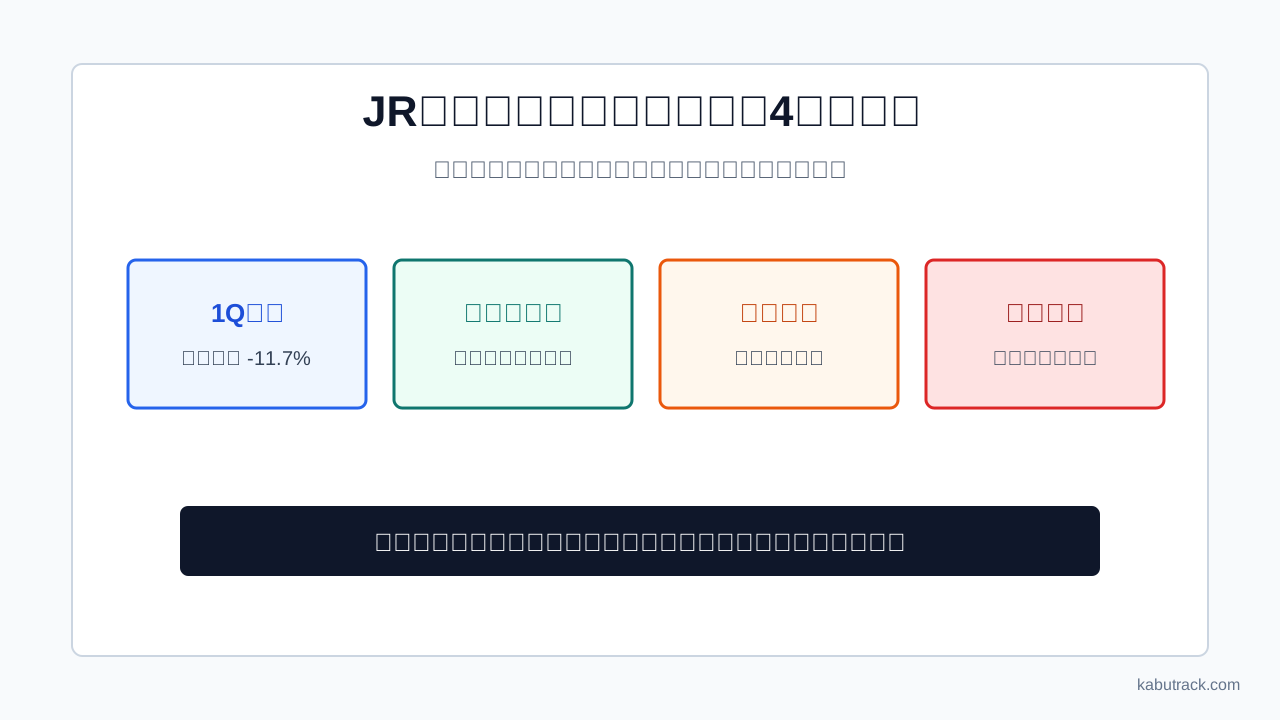
In the most recent first quarter of the fiscal year ending March 2027, sales were 424.4 billion yen, down 0.6% from the same period last year, operating income was 55.9 billion yen, down 11.7%, and quarterly net income attributable to owners of parent was 39 billion yen, down 20.1%. The decline in profits is large compared to the slight decline in sales, and this is likely to be reflected in the stock price as a "slowdown in profits after the recovery has run its course."
What's happening?
In the fiscal year ending March 2026, JR West achieved increased sales and profits due to the effects of the Expo, inbound tourists, and the opening of commercial facilities. From there, as we enter the fiscal year ending March 2027, the company's plans will include a reactionary decline.
It is easy for the market to honestly evaluate these kinds of railway stocks during the post-coronavirus recovery phase. However, once the recovery is complete, the story will change. In addition to increasing freight revenue, the question is whether a company can maintain profit margins by absorbing personnel costs, repair costs, electricity costs, equipment renewal, and interest costs.
Now comes the difficult part. This is not a story about JR West being sold because it is a bad company. In fact, its business foundation is strong. However, when it comes to stock prices, I care more about whether we can see the next source of profit growth than about a strong business.
Factors that can be seen as reasons for the decline
| Issues | View of the market |
|---|---|
| 1Q profit decrease | Operating income and net income decreased compared to the same period last year in 1Q of the fiscal year ending March 2027 |
| Expo/Inbound Reaction | The growth rate is likely to slow down due to the strong tailwind of the previous year |
| Increased costs | Labor costs, prices, repairs, and safety investments tend to put pressure on profits |
| Fluctuations in non-railway businesses | Profit margins change depending on the mix of distribution, real estate, hotels, etc. |
| Adjustment of expectations | After people buy based on expectations for recovery, reactions become slow even when there is good news |
Railway stocks in particular have a strong image of stable earnings, so the market reacts rather coldly to plans for lower profits or lower profit margins. It is more practical to look at the sustainability of profits and cash flow, rather than assuming that the downward price will be fixed only due to dividends and benefits.
Bullish scenario
The bullish side is the combined profits of the Sanyo Shinkansen, Keihanshin area, Hokuriku/Setouchi tourism, in-station areas, real estate, and hotels. If we look at it not just as a railway company, but as a company that can connect the flow of people to commerce, real estate, and a digital membership base, there is still room for evaluation.
If inbound tourism and domestic travel remain solid, and if developments around stations and hotel demand remain profitable, the market may view the rebound in the fiscal year ending March 2027 as a temporary adjustment. The fact that dividend forecasts are maintained also provides some support for long-term funds.
Bearish scenario
On the bearish side is a slowdown in passenger recovery coupled with rising costs. Railways have large fixed costs, and it is difficult to stop investment in renewals. If safety investments, labor costs, and prices continue to rise, profit margins will decline even if sales remain flat.
Furthermore, if the demand rebound after the Expo is larger than expected, it is easy to see that the strong performance in the fiscal year ending March 2026 was the peak. If the market determines that the recovery story has run its course, stock prices will find it difficult to follow the upward trend, even if the P/E ratio is not extremely high.
Featured KPIs
Revenue is not the only number that investors should look at.
-Rail transportation revenue and non-scheduled demand
- Usage status of Sanyo Shinkansen
- Operating income of distribution, real estate, and hotels
- Operating profit margin
- Operating cash flow
- Capital investment and interest-bearing debt
- Room to maintain dividend forecast
For JR West, the debate has shifted from a simple question of whether people will return to how much of the return can be monetized. If you make a mistake here, it will be difficult to read the stock price reaction even if you look at the financial results.
Wrap-Up
Worsening demand is not the only reason why JR West's stock price appears to be falling and weak. Rather, a major factor is that after the positive factors such as post-coronavirus recovery, World Expo, and inbound tourism were factored in, we started to see a slowdown in profits and an increase in costs.
The focus going forward is to what extent we can absorb the reactionary decline in the fiscal year ending March 2027. I would like to check railway demand, non-railway profits, operating cash flow, and capital investment burden, and consider whether the stock price will be reconsidered as a `stable railway stock'' or a `recovery stock''.
Related pages
- West Japan Railway Company (9021) stock analysis
- JR West (9021) Financial Results List
- JR West (9021) | Financial results announcement | Sales 424.403 billion yen (-0.6%) | First quarter results for the fiscal year ending March 2027
Source
- JR West “About the first quarter financial results of fiscal year 2026” (confirmed on August 8, 2026)
- JR West “IR Library” (confirmed August 8, 2026)