
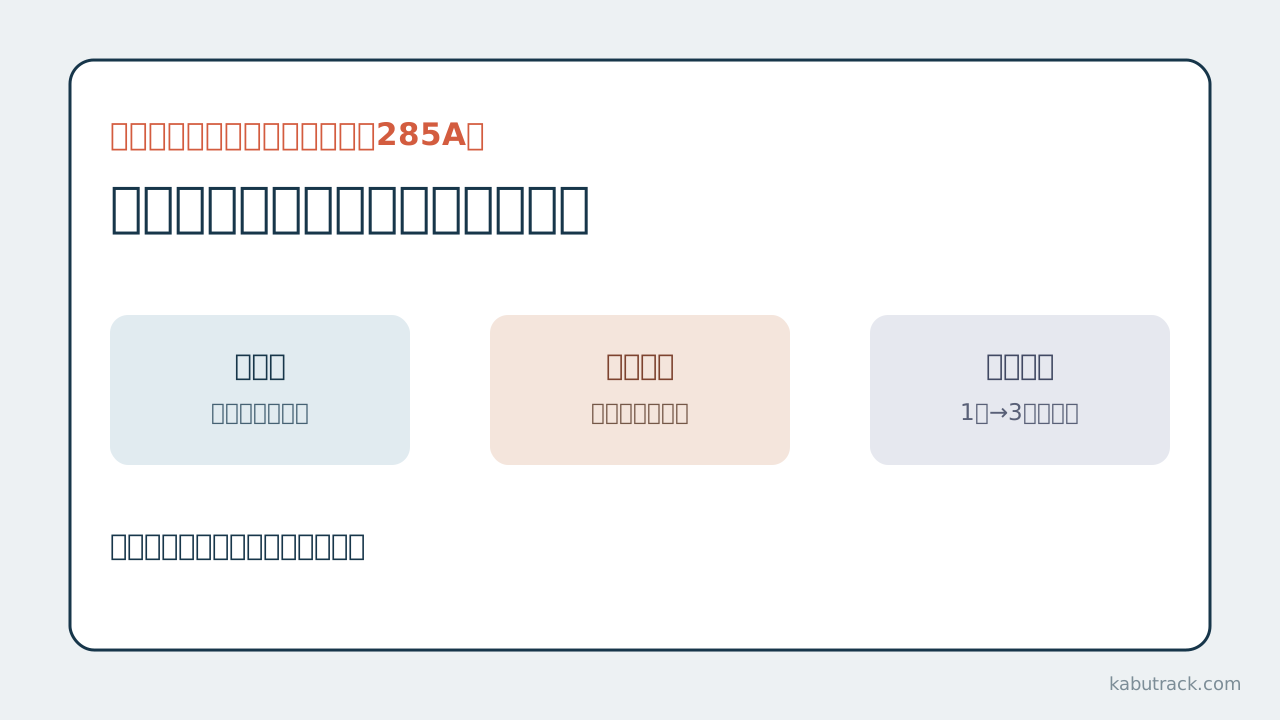
First, the conclusion
For stocks like KIOXIA, which have strong themes and whose stock prices fluctuate significantly, it is necessary to look not only at performance, but also at `who is in a position to sell,'' whether margin buying is accumulating,'' and `how the minimum investment amount changes the participants.''
On the other hand, supply and demand is an area where it is easy to attribute the cause later. Even if major shareholder sales, margin purchases, and stock price declines appear to occur at the same time, this alone does not prove a causal relationship.
Three facts that can be confirmed from official documents
Bain shareholders increased from 15.15% to 8.12%
According to company disclosure on February 26, 2026, BCPE Pangea Cayman, L.P.'s voting rights ownership percentage decreased from 15.15% to 8.12%. The number of shares held decreased from 81.78 million shares to 43,802,800 shares.
This indicates that there was a large-scale equity movement. However, it is not clear from this document the details of the parties to which the shares were sold or which entity moved the short-term stock price thereafter.
Investment unit was 500,000 yen or more
On May 15, 2026, the company disclosed a policy to reduce the investment unit because the investment unit as of March 31 was 500,000 yen or more. The level of ``stock price 100,000 yen, 1 unit 10 million yen'' that was mentioned in the original article cannot be confirmed in official materials, so it is excluded from the analysis assumptions.
Split 1 share into 3 shares on October 1st
On July 31st, the company announced a 3-for-1 stock split with September 30th as the record date. The objective is to lower the investment unit and widen the investor base. On the same day, we also set a limit for the acquisition of treasury stock.
Stock splits adjust the price and number of shares per share and do not directly increase corporate value. However, lowering the minimum investment amount may change participants and trading units, which may affect liquidity.
How to read the sale of major shareholders
PE funds sell their interests in order to recover their investment. The sale itself is not unusual. However, in the process of the market absorbing a large number of stocks, the following points can weigh on stock prices.
- Be wary of additional sales in the future
- Increase in free float
- Increase in existing shareholders who want to lock in profits at high prices
- Average purchase price increase for buyers
It doesn't necessarily mean that the price will go down just because a professional sold it. If business growth exceeds supply growth, the stock price may rise even after the sale. What we should look at is the balance between supply and demand and profit growth after the sale, rather than the fact of the sale.
How margin trading amplifies declines
When buying on margin, valuation losses increase due to stock price declines, and the guarantee deposit maintenance rate decreases. If you are unable to post additional margin, you may be forced to close your position.
株価下落 → 評価損拡大 → 保証金維持率低下
        → 追証・損切り → 売り増加 → さらに下落
This is a common mechanism. In order to determine the extent to which this actually occurred at Kioxia, we need a time series of daily published credit balances, individual stock margin trading balances, trading volume, and lending fees for lending transactions. It would be premature to conclude that margin buying caused the collapse without providing data.
5 numbers to see after stock split
| Indicators | How to read |
|---|---|
| Major shareholder ownership ratio | Presence and speed of additional sales |
| Credit buying balance | Amount that could lead to future selling pressure |
| Trading volume/trading value | Is the market able to absorb the supply? |
| NAND price/shipment volume | Backing of performance rather than theme |
| Operating income/CF | Will improved market conditions lead to cash generation |
Even if it becomes easier to buy after the split, it does not mean it becomes cheaper. You need to compare split-adjusted earnings, P/E ratio, and market capitalization.
Bullish/bearish scenarios
Bullish scenario: NAND supply and demand continues to improve, and profits and cash flows exceed market expectations. Splits and share buybacks will improve liquidity and supply and demand.
Bearish scenario: Memory prices reverse and expected lead valuations shrink. Additional sales by major shareholders and outstanding margin purchases will increase the number of sales.
Wrap-Up
When looking at Kioxia, it's best not to dismiss it with a single sentence like ``The stock crashed because Bain sold it.'' What we can confirm is a decline in the stake of major shareholders, a high investment unit, and the decision to split into three. It is practical to add credit supply and demand and semiconductor market conditions to this and update which data has the power to explain stock prices.
Related pages
- KIOXIA Holdings stocks page
- Examples of buying the top examples | How to look at the market price
- Don't grab a falling knife? Meaning and how to use it in investment decisions