
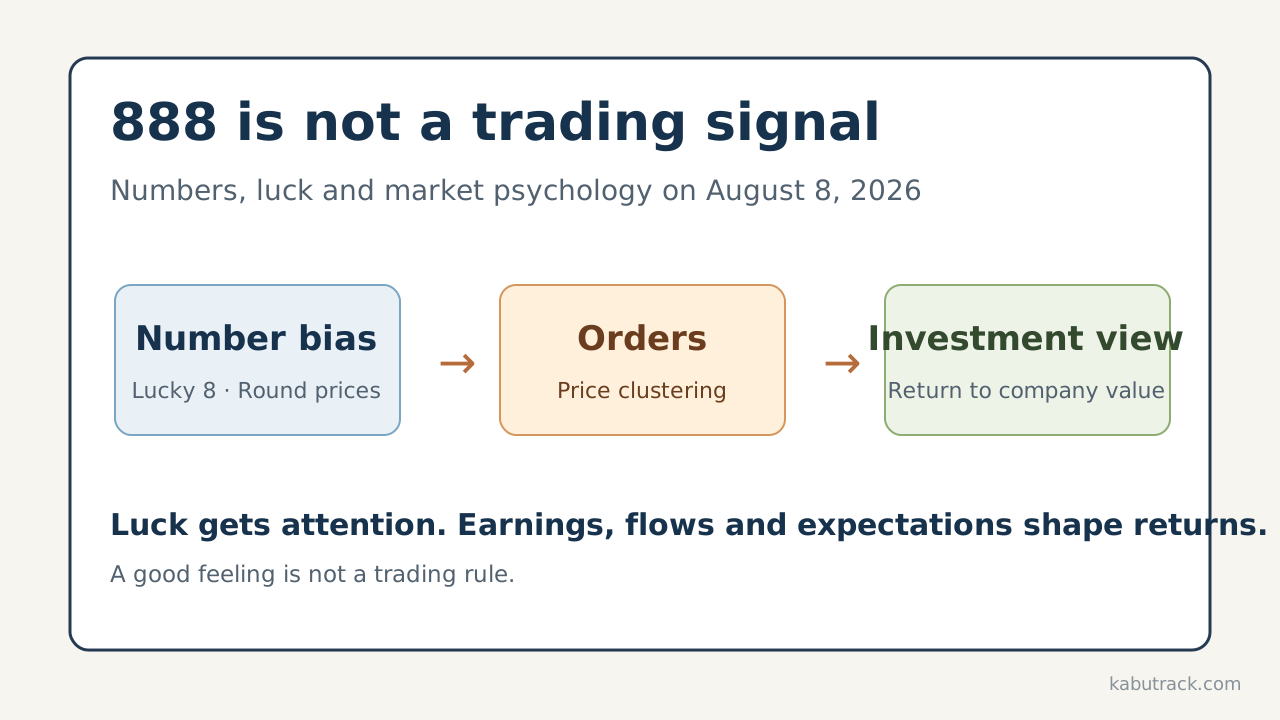
First, the conclusion
“888” is a prompt to examine investor psychology, not an investment theme.
In Japan, the character for eight widens toward the bottom, evoking growth and prosperity. That explains its appeal in business and celebrations; it says nothing about a company’s value.
The problem with the stock market is that cultural associations can feed into impressions of order prices, milestone prices, and stock codes. Numbers themselves do not have the power to increase corporate value. Still, if market participants give meaning to the numbers, it can influence short-term buying and selling and publicity.
Recognizing that bias is useful. Treating it as a trading rule is much harder to justify.
Why is “8” preferred?
One reason the character for eight is favored in Japan is its widening shape, associated with prosperity and growth.
Even in Chinese-speaking countries, `8'' is often treated as an auspicious number, while `4'', on the other hand, has been the subject of research as a number that is easy to avoid. What is important here is not whether the auspiciousness itself is good or bad, but whether investors carry that association into their prices and orders.
In the stock market, not every order comes from a precise calculation of a company's value. A typical example is price clustering, where orders tend to gather at milestones such as 1,000 yen, 1,500 yen, and 2,000 yen.
Even though numbers are not information, there are moments when they are treated as such. Reiwa 8, August 8, 2026 is a useful prompt for remembering this habit.
Preference for “8” was observed in the Chinese market
In a price clustering study targeting Chinese stocks, it was reported that cultural preference for numbers appeared in transaction prices and orders in the Shanghai and Shenzhen markets.
A study of Chinese stocks by Brown, Chua, and Mitchell identified price biases related to `8'' and `4'' in multiple market segments in the Shanghai and Shenzhen markets from the late 1990s to the 2000s. The purpose of the research is not to say, "If it's 8, the stock price will go up." More precisely, the numbers that investors prefer or avoid may bleed into fractions of order prices and the distribution of transaction prices.
Moreover, this type of effect is thought to weaken over time. If the number of market participants increases, information increases, and arbitrage and algorithmic trading become easier to enter, simple numerical bias will be less likely to persist.
In other words, while numerical luck is proof that there are people in the market, it is different from proof of sustainable excess returns.
Hong Kong market's "Lucky 8" is also not an investment method
A study titled “Lucky lots and unlucky investors,” using Hong Kong Stock Exchange trading data, found stronger net buying in board lots ending in “8.”
This result is interesting. This is because it indicates the possibility that individual investors are reacting to numbers that are not directly related to corporate value. Especially in situations where there is little information, people tend to rely on easily visible clues. Stock name, stock price peak, recent price movement, and the auspiciousness of the numbers. All of these are judgment materials that are often seen in the market.
Net buying does not establish that those investors made money. If a popular number attracts orders, some buyers may even pay a worse price.
Auspicious numbers do not eliminate risks.
A slightly cold reality revealed by research on IPO codes
Hirshleifer, Jian, and Zhang's study of China's IPO market found that listing codes containing numbers believed to be auspicious were more frequent than would be expected by chance.
Up to this point, we can suffice with the question, ``Do companies and market participants also pay attention to numbers?'' What's more important for investors is what comes after. The same study also shows that newly listed companies with lucky listing codes have relatively low post-IPO abnormal returns.
It may be that a brand that looks auspicious is more likely to attract expectations from the beginning. If expectations affect prices first, the returns left for investors who buy later will be thinner. This is a very market-like story.
In fact, ``it seems like a good omen'' can also be a gateway to built-in risks.
After all, sentiment is stronger than numbers
A study published in 2024 covering the Shanghai and Shenzhen markets from 2000 to 2020 analyzed stocks with good and bad numbers and crowd behavior in the market as a whole.
The study did not find clear evidence of stronger herding in stocks with auspicious numbers. Market-wide sentiment appeared more influential.
This is important when looking at investor psychology. Although numbers are conspicuous, in the actual market, performance expectations, interest rates, margin trading supply and demand, theme selection, overseas investor flows, and index milestones often have a stronger effect.
``8'' becomes a hot topic. However, if the entire market is risk-off, you won't get your money back just by lucky numbers.
The “wall of numbers” you should see in Japanese stocks
Even in Japanese stocks, there are numerical barriers everywhere.
| Numbers that are easily noticed in the market | How they affect investor psychology |
|---|---|
| Stock price 1,000 yen, 5,000 yen | Easy to use as a guideline for limit price, profit taking, and loss cutting |
| Nikkei average at a round-number milestone | Often draws headlines and retail attention |
| Highest price since listing, highest price since the beginning of the year | Momentum investing and profit-taking selling tend to collide |
| P/E of 10, P/B of 1 | Simple reference points for valuation and capital efficiency |
| Dividend yield 3%, 4%, 5% | Yield investors are likely to buy |
These numbers are more practical than stock code auspices. PER, PBR, and dividend yield are linked to corporate value and shareholder returns, so they are easy to explain to investors.
However, numbers are not a panacea. A company is not bought because its PBR is below 1x, but is reevaluated only when its ROE improvement, capital policy, quality of profits, and sustainability of shareholder returns are all in place. Even if the dividend yield is high, if there are strong concerns about the dividend being cut, the yield will not be supported.
The market looks at the numbers. However, I also look behind the numbers quite a bit.
What investors want to know on Reiwa 8, August 8, 2026
It's natural to see the sequence "888" and think that something good will happen. The problem is to carry that feeling directly into buying and selling.
If you go back to investment decisions, the order in which you watch them will be quite simple.
| What to look at, not auspicious origins | Points to check |
|---|---|
| Performance | Are not only sales, but also operating income, EPS, and profit margins increasing? |
| Cash flow | Can you generate cash from your core business to support investments and returns |
| Financial position | Are debt, equity and cash flow in balance? |
| Valuation | Are PER, PBR, EV/EBITDA too high compared to expectations |
| Supply and demand | Are there any margin purchases, floating stocks, lock-ups, or supply/demand events? |
| Shareholder returns | Are dividends and buybacks supported by profit and cash? |
It is more practical to think about why the stock price does not react even with good financial results than whether there is an 8 in the stock code. Is it due to high expectations, profit-taking, full-year plans that are unsatisfactory, or credit supply and demand being heavy?
Look at the discrepancy in expected values, not the appearance of the numbers. If you want to use investor psychology, that's it.
What “widening prosperity” means for investors
Since this is Reiwa 8, August 8, 2026, it is worth translating the idea of "suehirogari," or widening prosperity, into investor terms.
The useful version is less poetic: research the company, weigh the price, diversify risk and decide in advance what would change your view. In a rising market, be able to say why you remain optimistic.
It may be a little plain, but the true potential of investment should be close to this.
Rather than looking for lucky numbers, increase the number of factors you can use to make decisions without relying on luck. Reiwa 8, August 8, 2026 is best treated as a day for that kind of check.
Wrap-Up
"888" is not a good omen, but rather an opportunity to think about investor psychology.
Studies from China and Hong Kong show that numerical cues are manifested in order and price formation. However, this effect weakens with the maturity of the market and the amount of information, and is not directly linked to investment results. In fact, good luck may lead to higher expectations and a perception of being overpriced.
The stock market is a world driven by numbers. Stock price, PER, PBR, yield, and index levels. It is true that numbers attract the attention of investors.
However, in the end, what you should look at is not a lucky-looking number, but the company's earning power, cash, financial position, and expectations already factored into the price. "888" on Reiwa 8, August 8, 2026 is not a buy or sell signal; it is a cue to check whether psychological shortcuts have slipped into your decisions.
Sources
- Elaine Chong, Ming Liu, Oliver Rui「Lucky lots and unlucky investors」Lingnan Scholars
- David Hirshleifer, Ming Jian, Huai Zhang「Superstition and Financial Decision Making」SSRN
- Thomas Schneider, Sun Na「The Use of 'Lucky' Numbers in the Pricing of Chinese A-Share Initial Public Offerings」SSRN
- International Review of Financial Analysis「Numerological superstitions and market-wide herding: Evidence from China」ScienceDirect
- ResearchGate「Cultural Stock Price Clustering in the Chinese Equity Market」