
The Main Point
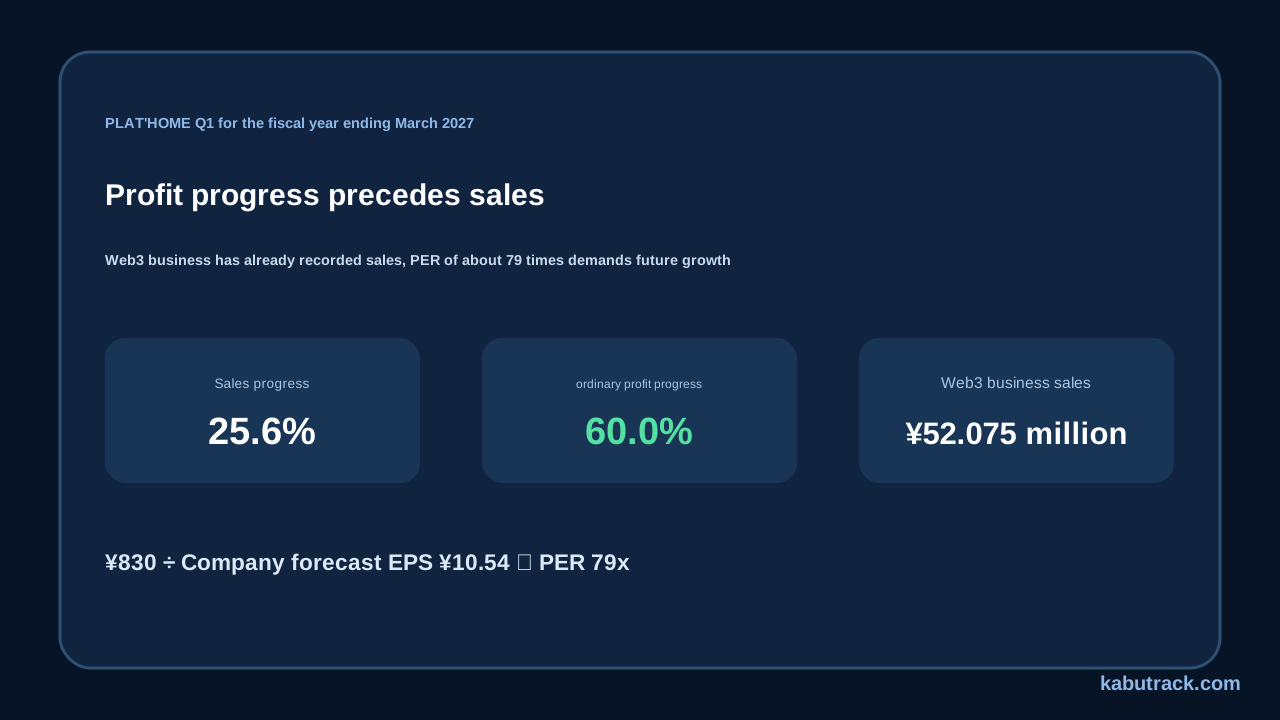
This year’s Q1 is strong if you look at the headlines alone. However, although sales are only about a quarter of the way, ordinary profit has progressed to 60% of the full-year plan. Although the advance in profits is welcome, the first half forecast is almost completely covered by Q1 alone. Profit is concentrated early in the year.
Web3 already has disclosed segment sales, so this is no longer a story built solely on hopes from a zero-revenue starting point. The question is whether the sales of ¥52.07 million will not end with a one-off development project, but will it become a business that accumulates profits. The P/E ratio of approximately 79 times based on ¥830 is an evaluation with high expectations.
Q1 sales: 25.6%, ordinary profit: 60%
Sales for Q1 of the fiscal year ending March 2027 were ¥401.64 million, operating profit of ¥34.08 million, ordinary profit of ¥33.01 million, and net income of ¥32.02 million. The company's full-year forecast is sales of ¥1.57 billion, operating profit of ¥60 million, ordinary profit of ¥55 million, and net income of ¥50 million.
Sales progress was 25.6%, while ordinary profit was 60.0%. The first thing that concerns me about this Q1 is the speed of profit progress. As consolidated financial statements were not prepared for the same period last year, comparisons with the previous year are not disclosed. Rather than the growth rate, we first look at the absolute amount and how profits are generated.
Furthermore, the interim ordinary profit forecast revised on August 7th is ¥34 million. Q1 alone reached 97% of that. If we make a simple deduction, the ordinary profit remaining in Q2 is ¥1 million. Although these numbers are not the company's promise of profit for Q2 alone, it can be seen that the first half forecast is largely based on the high profit of Q1. It would be too early to take an upward revision in the interim period as a signal of an upward trend for the full year.
The company has left its full-year forecast unchanged. The company explained that in the second half of the year, there will be uncertainty about the impact of tight semiconductor supply and rising prices on demand from major customers, and the acquisition and progress of Web3 business projects. Looking only at the progress in Q1, it is easy to expect an upside. Still, the company has not made any changes to its full-year forecast.
PER approximately 79 times against EPS 10.54 yen
Dividing the reference price of ¥830 during the 11 a.m. hour on September 25 by the company's forecast EPS of ¥10.54 gives a PER of 78.7x. This is a trial calculation using the stock price during the 11 a.m. hour that day, and is not a PER based on the closing price.
At this multiple, it is difficult to explain why the company is undervalued simply because its existing network equipment business is strong. At the very least, it is difficult to think that this is a stock that is being bought based solely on the company's forecast EPS of 10.54 yen, and it is natural to think that expectations for profit expansion from next fiscal year onwards, including Web3, are riding on it. It is not possible to determine how many yen worth of Web3 expectations are on the stock price.
With a PER of 79x, just having a good Q1 is not enough. Will the next IR end with "We have partnered" or will it include numbers? This difference will be large.
Web3 Has Revenue; Individual Project Contributions Remain Unclear
In Q1, the Web3 business had sales of ¥52.075 million and segment profit of ¥17.73 million. It accounts for approximately 13% of the company's total sales, and is already showing numbers as a business segment. At least we are not at the stage where we can't see sales for Web3 yet. However, how to evaluate this ¥52.07 million is another matter.
Network business had sales of ¥349.57 million and segment profit of ¥76.56 million. Segment profit combined with Web3 is ¥94.29 million, but after subtracting adjustments such as company-wide expenses of ¥60.21 million, consolidated operating profit is ¥34.08 million. The majority of this adjustment amount is general and administrative expenses that are not allocated to each segment. If you only look at segment profits and read that “Web3 will directly increase company-wide profits,” you will misunderstand the reality.
ThingsToken has been adopted as the technology base for Logizard's "Bit Waybill", and demonstration experiments are continuing at the Nebuta Festival DAO. The company announcement on September 24th was an interview with the company's representative on NFT specialized media, and was not a new large-scale contract or a revision to its business results. While it is easy to buy theme stocks based on their future prospects at the "entry", "partnership", and "demonstration" stages, once segment sales increase, the market's focus shifts to numbers. Plat’Home is also on the border. The breakdown of Q1's ¥52.07 million has not been disclosed and cannot be linked to sales of specific projects such as Bit Waybill.
Network business is a mainstay of profit, but inventory and price pass-through are difficult
The network business had Q1 sales of ¥349.57 million and segment profit of ¥76.56 million. In addition to EasyBlocks sales, the company says it has increased long-term support contracts. The network business remains the current profit engine.
From April 15, the company changed its pricing for OpenBlocks, EasyBlocks, etc. to reflect the component market conditions at the time of order. It seems that the company is not dealing with price fluctuations alone, but whether customers will place orders even at that price is another story. The next thing to look at is sales volume and gross profit margin, rather than price increases themselves.
Another thing that lies behind profits is inventory. Inventories at the end of Q1 increased by ¥72 million from the end of the previous fiscal year. The company explains that operating cash flow has become significantly negative due to increased inventory in anticipation of rising raw material prices. On the other hand, the cash flow statement for Q1 has not been created, and the amount and breakdown cannot be confirmed from the earnings release. Cash and deposits total ¥219 million, but operating profit alone does not reveal the working-capital burden.
Figures to Watch in November’s Interim Results
Next time, it will not be enough to just follow the "progress of Web3". According to the company's IR calendar, the interim financial results are scheduled for early November. You can narrow down the items you see to three.
- First-half profit results: What will happen to the Q2 results and explanation of the full-year plan compared to the ordinary profit forecast of ¥34 million, which was almost reached in Q1?
- Web3: How much can the company add to sales in Q2 compared to ¥52.07 million in Q1?
- Cash and inventory: Will the inventory accumulated in anticipation of higher component prices turn into sales and gross profit, and will the outflow of operating cash ease?
Conclusion
Earnings progress in Q1 was strong, with Web3 also posting sales. On the other hand, it is difficult to explain the PER of approximately 79 times based on the company's expected EPS alone, and the evaluation also involves profit growth from the next fiscal year onward. In the next financial results, I would like to see the numbers, including whether inventory will turn into sales.
Related Articles
- Platt (6836) | Financial results announcement | Sales ¥400 million | First quarter results for the fiscal year ending March 2027
- Plat’Home (6836) Stock Analysis
Sources
- Plat’Home “Fiscal Year Ending March 2027 (35th Period) First Quarter Financial Results”
- Plat’Home “Revision of financial forecasts for the second quarter (interim period) of the fiscal year ending March 2027”
- Plat’Home “IR Calendar”
- Plat’Home “ThingsToken adopted as Bit Waybill’s technology base”
- Plat’Home “Nebuta Festival DAO Demonstration Experiment 2nd”
- Plat’Home “Interview article with our company representative published on NFT Media”
- Plat’Home “Notice regarding product price”