
The Main Point
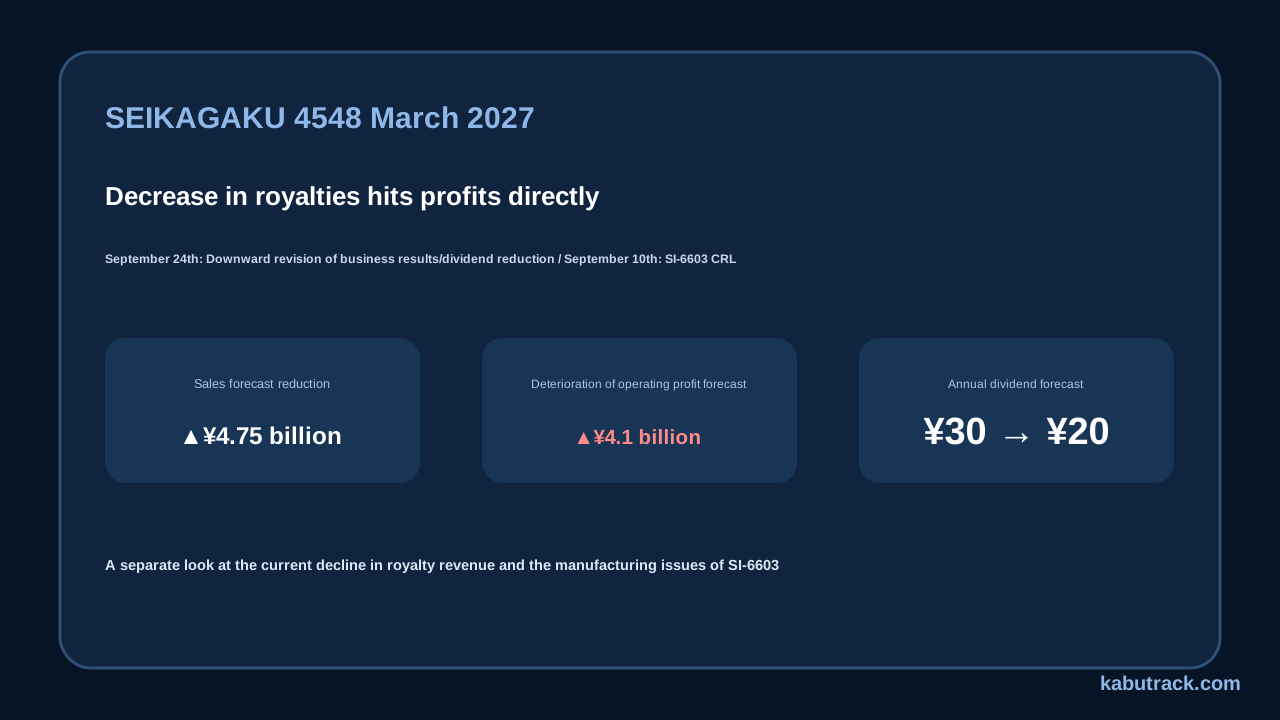
What is notable about this downward revision is that the sales forecast was cut by ¥4.75 billion while the operating profit forecast fell by ¥4.1 billion. The company cited a significant decline in royalty income as the main reason. Although there is no breakdown by item in the revised materials, the numbers show the magnitude of the impact that fluctuations in royalty income have on operating profit.
Also, SI-6603 received a CRL from the FDA on September 10th. It is described as a manufacturing facility issue rather than a clinical data concern, but the timeline for correction and resubmission is unclear. The reason for the September 24th earnings revision was a decrease in royalties, and the company has not shown a direct causal relationship with CRL. It seems better not to combine current and future risks into one.
September 24 Revision: Sales Forecast Down ¥4.75 Billion, Operating Profit Down ¥4.1 Billion
The full-year forecast for the fiscal year ending March 2027 has changed as follows.
| item | Previous forecast | Revised forecast | Change |
|---|---|---|---|
| Sales | ¥41.85 billion | ¥37.1 billion | ▲¥4.75 billion |
| operating profit | ¥2.05 billion | ▲¥2.05 billion | ▲¥4.1 billion |
| ordinary profit | ¥4.2 billion | ¥200 million | ▲¥4 billion |
| net income | ¥2.25 billion | ▲¥1.8 billion | ▲¥4.05 billion |
| annual dividend | ¥30 | ¥20 | ▲¥10 |
Operating profit has fallen from a surplus forecast to a deficit forecast. The company cites a significant decrease in royalties as the reason for the decrease in sales, and explains that operating profit will also decrease as a result of this decrease in sales. The decrease in sales was ¥4.75 billion, and the deterioration in operating profit was ¥4.1 billion. The amount of revenue reduction and the hit to profits are quite similar. The company's explanation suggests that profits are highly sensitive to changes in royalty income.
This is a model in which a company entrusts the sales of pharmaceuticals to its partners and allocates management resources to research, development, and manufacturing. In the financial results report, the company explains that its pharmaceutical royalties are mainly based on milestone payments based on the progress of research, development and sales. Although the breakdown by product and project has not been made public, changes in royalty income have had a significant impact on operating profit in this revision.
An Operating Loss but an Ordinary Profit: Where Does the Difference Come From?
The revised operating loss is ¥2.05 billion, but the ordinary profit is expected to be ¥200 million. The difference between the two is ¥2.25 billion. It is incorrect to read this as “the core business has recovered because ordinary profit is positive.”
This is not a numerical anomaly. Q1 on August 5th had an operating loss of ¥943 million and an ordinary profit of ¥108 million. Non-operating income of ¥1.062 billion included gains on sales of investment securities of ¥699 million, foreign exchange gains of ¥74 million, and dividend income of ¥253 million. In its full-year forecast in May, the company expected to sell investment securities and expected ordinary profit to be ¥4.2 billion.
The revised materials dated September 24th do not show the breakdown of non-operating income and expenses that support the revised ordinary profit of ¥200 million. Q1 alone reached 54% of the revised full-year forecast, and in Q1, gains on sales of investment securities were included in non-operating income. It is too early to read this progress in conjunction with the earning power of the company's core business. The operating loss of ¥2.05 billion is a difficult number to judge the earning power for this period.
The annual dividend forecast was also lowered from ¥30 to ¥20. This is a one-third dividend reduction. The deterioration in business performance affected shareholder returns. This is not a small adjustment for shareholders who place importance on dividend income.
September 10 CRL: Manufacturing Facilities, Rather than Clinical Data
Regarding the CRL for SI-6603, the company lists two manufacturing facilities. At the drug substance manufacturing facility, past inspection findings have not been completely resolved, and a new cGMP inspection of a pharmaceutical manufacturing subcontractor has required improvements. There have been no concerns regarding clinical trial results, including efficacy or safety, or requests for additional clinical trials.
Although the word CRL is heavy, the point of discussion this time is not the drug efficacy data but the correction of manufacturing aspects. However, this is not the first time that manufacturing and quality control have become a barrier to screening. After receiving a CRL in March 2025, the company re-applied in March 2026 in response to manufacturing and quality control issues. This time, the findings regarding the drug substance manufacturing facility remain, and new findings have also been raised at the pharmaceutical manufacturing subcontractor. Since manufacturing facilities once again became an issue during the post-reapplication review, many investors are likely to push back their assumed approval timelines. The company has said it will consider reapplying early, but has not given a date.
At the time of the September 10th announcement, the company was examining the impact of CRL on its full-year earnings forecast. Two weeks later, on September 24, the company lowered its full-year forecast and dividend. From an investor's perspective, it looks like the bad news continued in September, but the reason for the revision on the 24th is a decrease in royalty income. It is unreasonable to read the CRL as the direct cause of the downward revision based on company materials.
Three things to check in the November interim financial results
The company plans to announce interim results in early November. In the next disclosure, we can narrow down the discussion to three points.
- Royalty income: How long will the decline in revenue continue? This will help determine the bottom of the full-year forecast.
- SI-6603: Will the status of corrections to cGMP findings and timing of re-application be indicated?
- Operating loss: Assuming a full-year operating loss of ¥2.05 billion, how much of the manufacturing and R&D costs can be absorbed after the decrease in royalty revenue?
Conclusion
Recently, the decrease in royalties has pushed down operating profit, and the annual dividend has been reduced by one-third. Regarding SI-6603, a potential future catalyst, correction of manufacturing and quality control is once again an issue. No timetable has yet been given for reapplication. Where will royalties bottom out and how far will operating losses of ¥2.05 billion be covered? Until we see the dates and numbers, it is difficult to predict the scope of recovery.
Related Articles
- Seikagaku (4548) | Financial results announcement | Sales ¥8.833 billion (+1.2%) | First quarter results for the fiscal year ending March 2027
- Japanese Stock Evening Edition: 9/24 4 noteworthy items | Nikkei average ¥495 higher due to semiconductors, TOPIX falls
- Seikagaku Corporation (4548) Stock Analysis
Sources
- Seikagaku Corporation “Revision of full-year consolidated earnings forecast for the fiscal year ending March 2027, announcement of full-year non-consolidated earnings forecast, and revision of dividend forecast”
- Seikagaku Corporation “Receipt of a Complete Response Letter for the U.S. Application for SI-6603”
- Seikagaku Corporation “Re-application for US approval of SI-6603”
- Seikagaku Corporation "Research and Development"
- Seikagaku Corporation “Summary of first quarter financial results for the fiscal year ending March 2027”
- Seikagaku Corporation “Summary of Financial Results for the Fiscal Year Ending March 2026”
- Seikagaku Corporation “IR Schedule”