50,000 Yen a Month Is 600,000 Yen a Year
Investing 50,000 yen a month equals 600,000 yen a year.
New NISA's accumulation investment quota is 1.2 million yen per year, so 50,000 yen a month uses half of that quota.
50,000 yen x 12 months = 600,000 yen per year
600,000 yen x 20 years = 12 million yen
600,000 yen x 30 years = 18 million yen
The interesting point is that 30 years of contributions bring the principal to 18 million yen.
New NISA's lifetime tax-free holding limit is 18 million yen.
In other words, if you invest 50,000 yen a month for 30 years, you can reach the lifetime limit without forcing yourself to use the full annual quota.
20-Year and 30-Year Simulation
Here are rough estimates for investing 50,000 yen a month over 20 and 30 years.
This assumes annual returns of 3%, 5%, and 7%, without considering taxes or fees.
| Investment Period | Principal | 3% per year | 5% per year | 7% per year |
|---|---|---|---|---|
| 20 years | 12 million yen | About 16.42 million yen | About 20.55 million yen | About 26.05 million yen |
| 30 years | 18 million yen | About 29.14 million yen | About 41.61 million yen | About 61.00 million yen |
Looking only at the numbers, 50,000 yen a month is powerful.
But this table assumes you can continue investing 50,000 yen every month for a long time.
If household finances become tight and you sell along the way, or if you stop contributions during a weak market, the result can change significantly.
Who Is 50,000 Yen a Month Suited For?
Investing 50,000 yen a month suits people like these.
- You already have emergency savings
- Your monthly income and spending are consistently in surplus
- You still have room after considering mortgage and education costs
- You want to build retirement funds in earnest
- You have at least 20 years
As an asset-building amount, 50,000 yen has real power.
But it is also a large presence in the household budget.
For someone with monthly take-home pay of 250,000 yen, it is 20%. For someone with take-home pay of 500,000 yen, it is 10%. The burden of the same 50,000 yen feels very different.
Decide based on your own fixed costs and surplus funds, not someone else's contribution amount.
If 50,000 Yen Is Too Much, 30,000 Yen Is Fine
Even if 50,000 yen looks ideal, you can start with 30,000 yen if 50,000 yen is too heavy.
At 30,000 yen a month, 20 years of principal is still 7.2 million yen.
If it could be invested at 5% per year, the rough estimate after 20 years would be about 12.33 million yen.
The important thing is not to start with the largest amount possible.
Start with an amount you can continue, then increase when household finances allow.
Start with 30,000 yen/month
↓
Continue for six months to one year
↓
Increase to 50,000 yen if household finances allow
This order makes it easier to avoid giving up midway.
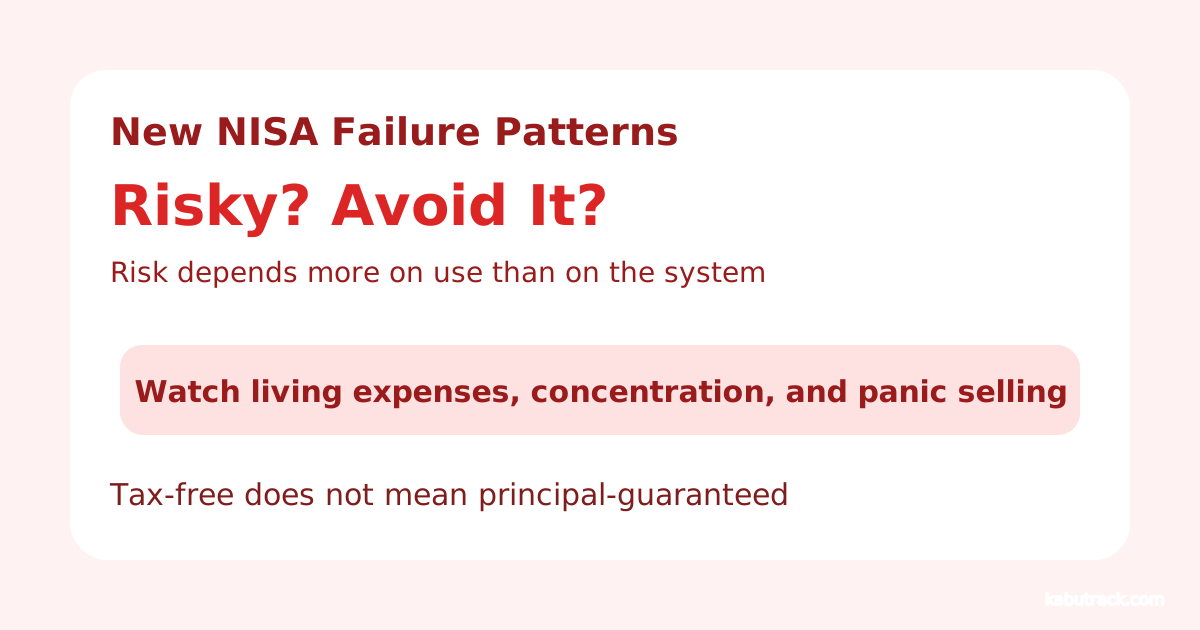
Common Failure Patterns With 50,000 Yen a Month
Most failures with 50,000 yen monthly investing come from poor design rather than the amount itself.
| Failure | Problem |
|---|---|
| Starting without emergency savings | You may have to sell during sudden expenses |
| Underestimating mortgage or education costs | Contributions may become hard several years later |
| Putting everything into equities | Psychological burden during crashes can be large |
| Copying success stories on social media | Household conditions are different |
| Making quota-filling the goal | The purpose of investing gets distorted |
Sudden expenses deserve particular attention.
Cars, broken appliances, medical costs, moving, and education expenses can all require cash.
If your only option is to sell NISA holdings at that point, you may end up selling during a weak market.
Think About the Exit If It Is for Retirement
If you invest 50,000 yen a month for a long time, you also need an exit strategy.
An exit strategy means deciding how to draw down assets in retirement.
Possible approaches include:
| Withdrawal Method | Feature |
|---|---|
| Sell only when needed | Flexible, but requires selling decisions |
| Sell a fixed amount every year | Easier for household planning |
| Mainly sell gains | Easier to preserve principal, but depends on markets |
| Cover only pension shortfalls | Fits retirement spending management |
When accumulating, it is natural to focus on how much assets may grow.
But if the money is for retirement, it is more realistic to think about when and how much to withdraw.
Summary
If you invest 50,000 yen a month in New NISA, your principal is 12 million yen after 20 years and 18 million yen after 30 years.
At 3% to 5% per year, rough estimates are about 16.42 million to 20.55 million yen after 20 years and about 29.14 million to 41.61 million yen after 30 years.
This is not a guarantee of future results.
50,000 yen a month is a powerful amount, but if it strains your household budget, starting with 30,000 yen may be easier to continue.
When building retirement funds with New NISA, prioritize a sustainable household design over the size of the monthly amount.