
What investors should consider when analyzing a company is not to simply conclude that the company's finances are safe because it has a subordinated equity loan. Although there is a financial improvement effect, we would like to confirm why the funds were needed, whether the funds could not be raised through existing borrowings, and whether profitability would return by the repayment deadline.
This article provides a general explanation of the structure of subordinated equity loans, and does not recommend the use of specific companies, financial products, financing systems, or investment decisions. Actual plan conditions, interest rates, eligible persons, repayment terms, and screening requirements are subject to change. Please check official documents, contracts, financial institution instructions, and expert advice when making usage/investment decisions.
What is a subordinated equity loan?
A subordinated equity loan is a type of loan that a company receives from a financial institution.
However, the characteristics are different from ordinary bank loans. The biggest feature is that it comes with a subordination clause.
If a company enters into legal bankruptcy proceedings, subordinated equity loans will be repaid later than general borrowings or straight bonds. The image of the payment order is as follows.
預金・担保付き借入・一般融資
  ↓
普通社債・一般債権
  ↓
資本性劣後ローン
  ↓
株式
Subordinated equity loans are not completely equity like equity. However, they are in a position where they are more susceptible to losses than ordinary borrowings.
This position of being ``lower than ordinary debt and above equity'' is what makes subordinated equity loans difficult to understand, and also has a practical meaning.
Why is it called “capital nature”?
Subordinated equity loans are treated as borrowings for accounting purposes.
Still, it is called ``equity credit'' because when financial institutions look at a company's financial situation, they sometimes evaluate borrowings that meet certain conditions as being close to equity.
There are three main reasons why it is often seen as close to capital:
| Features | Reasons why it is seen close to capital |
|---|---|
| Subordination | Has a lower repayment priority than other debts and has loss absorption capacity |
| Long-term | Long repayment period, less likely to put pressure on short-term cash flow |
| Deferment of principal repayment | It is likely that the design will not require repayment of principal for a certain period of time |
The Japan Finance Corporation's capital loans also explain that they will be subordinated to other debts in the event of legal bankruptcy proceedings, and that they will help strengthen the financial structure and facilitate the procurement of funds from private financial institutions.
In other words, subordinated equity loans are funds that can be seen as equity even though they are debt.
However, make no mistake here. Just because a debt is assessed as equity does not mean that the debt disappears. Ultimately, the funds will need to be repaid, and the burden will remain if the company is unable to recover profits.
Differences from regular loans
If you compare a regular bank loan and a subordinated equity loan, the difference is quite large.
Both are legally debts. I want to focus on this first.
A regular loan is a simple loan in which a bank lends money to a company, and the company receives repayment within a set period.
A subordinated equity loan is also a loan. However, due to their low repayment ranking and long repayment period, they may be evaluated by financial institutions as being close to capital. In other words, even though the debt is the same, it is positioned much closer to equity than a regular loan.
| Item | Ordinary loan | Subordinated equity loan |
|---|---|---|
| Legal nature | Borrowings | Borrowings |
| Repayment rank | Relatively high | Lower than general debt |
| Repayment period | Often short to medium term | Tends to be long term |
| Principal repayment | Depends on conditions such as installment repayment or lump sum on the due date | Principal repayment is likely to be postponed or lump sum on the due date |
| Interest payment | In principle, pay according to the contract | Deferment may be designed depending on the conditions |
| Interest rate | Relatively low | Tends to rise depending on risk |
| Financial evaluation | Viewed as a liability | A portion may be evaluated as close to equity |
| Lender risk | Relatively low | High |
| Usage scenarios | Normal working capital/equipment funds | Business revitalization, growth investment, strengthening financial structure |
Regular loans have a high repayment priority for lenders, and the repayment terms are relatively simple.
With subordinated equity loans, the lender takes on more risk. That is why, while it has the effect of improving finances for borrowing companies, business plans and financial institution screening are important when using the system.
Simplifying the ranking of repayments in the event of a company's bankruptcy, we get the following image.
担保付き融資
  ↓
普通融資
  ↓
普通社債・一般債権
  ↓
資本性劣後ローン
  ↓
株式
Subordinated equity loans are at a much lower end. As a result, lenders take on a large amount of risk. On the other hand, from the perspective of borrowing companies, it is precisely because of this subordination that they tend to evaluate the funds as funds that strengthen their financial base.
Difference from subordinated loan
A subordinated equity loan is a type of subordinated loan.
The biggest difference between the two is whether financial institutions and rating agencies evaluate them as close to their own capital.
劣後ローン
  ├─ 通常の劣後ローン
  └─ 資本性劣後ローン
Ordinary subordinated loans are primarily "loans with a low repayment priority." The lender's risk is higher because it is repaid later than a regular loan, but it is not necessarily evaluated as funds close to equity.
Subordinated equity loans are designed to be even more like equity. They may have features such as a long repayment period, a grace period for principal repayment, strong subordination, and the ability to defer interest payments depending on the terms.
| Item | Subordinated Loan | Subordinated Equity Loan |
|---|---|---|
| Repayment rank | Low | Low |
| Subordination clause | Yes | Yes |
| Evaluation close to equity | Usually limited | May be evaluated under certain conditions |
| Duration | Varies depending on the project | Tends to be long |
| Interest deferral | Usually not a central feature | May be designed depending on conditions |
| Financial improvement effect | Often limited | May be relatively large |
For beginners, a subordinated loan is a debt that has a low repayment priority, and a subordinated equity loan is a debt that has a low repayment priority and is sometimes evaluated as equity.
Why do companies use subordinated equity loans?
Companies use subordinated equity loans not only because they want to borrow funds.
The big thing is to improve the way financial institutions view their finances, making it easier to obtain additional loans and continue transactions.
For example, suppose a company's financial situation is as follows.
| Item | Amount |
|---|---|
| Borrowings | 10 billion yen |
| Equity capital | 2 billion yen |
In this situation, the debt appears to be quite large compared to the company's equity. Simply increasing ordinary loans will likely increase the risk from the financial institution's perspective.
If a subordinated equity loan is introduced here, some financial institutions may evaluate a portion of the loan as being close to equity. As a result, the company's financial base appears to have been strengthened, which may make it easier to negotiate additional financing or refinancing.
However, this does not mean that accounting equity will automatically increase. This is simply a matter of being treated as funds with characteristics similar to capital in the evaluation of financial institutions and rating agencies.
It's dangerous if you make a mistake here. Subordinated equity loans are funds that give companies time, but they do not generate profits or cash flow. If the business does not recover after borrowing, it will remain a long-term repayment burden.
Positioning in overall funding
A subordinated equity loan is more like equity than a regular loan, but not as complete equity as a common stock.
If we sort funding by strength of capital, we get the following image.
普通融資
  ↓
社債
  ↓
資本性劣後ローン
  ↓
優先株
  ↓
普通株
The lower you go, the lower the repayment ranking tends to be, and the risk for lenders and investors tends to increase. Instead, from a company's perspective, it becomes more meaningful to support the financial base as funds that are similar to equity capital.
However, this is not a strict legal ranking. The actual repayment order and loss absorption mechanism will vary depending on contract terms and product design.
Difference from subordinated debt
Both subordinated equity loans and subordinated debt have subordination.
However, the shape is different.
| Item | Subordinated equity loan | Subordinated debt |
|---|---|---|
| Type | Loan | Bond |
| Funding providers | Government financial institutions, banks, etc. | Investors, financial institutions, etc. |
| Market buying and selling | Usually not | May be bought and sold in the bond market |
| Subordination clause | Yes | Yes |
| Equity assessment | Evaluated according to conditions | Evaluated according to conditions |
| Point of contact for individual investors | There are few opportunities for direct investment | May be sold as subordinated bonds to individuals |
From an investor's perspective, a subordinated equity loan is not a product to be purchased directly, but rather an item to be looked at in a company's financial analysis.
For example, even if a company's equity ratio appears to be improving, if there are subordinated equity loans behind this, we should be a little cautious about how we view the company's actual safety. This is because although it has equity characteristics, it is different from stocks that do not require repayment.
The essential difference between a subordinated loan and a subordinated bond is whether it is a loan agreement or a bond. When looking at risk, you want to check not only whether it's a loan or a bond, but also the repayment order, maturity, interest payment terms, and whether or not it has equity characteristics.
Differences from AT1 bonds
AT1 bonds are equity securities designed to comply with banks' capital regulations.
If subordinated equity loans and AT1 bonds are grouped together as "money that is close to equity," it is easy to misunderstand the risk.
| Item | Subordinated equity loan | AT1 bond |
|---|---|---|
| Main users/issuers | General companies, small and medium-sized enterprises, business restructuring companies, etc. | Mainly banks |
| Type | Financing | Bonds/Securities |
| Principal reduction clause | Generally not as strong as AT1 bonds | May have principal reduction/equity conversion clause |
| Contact points for investors | Often seen in corporate analysis | May be purchased as a bond investment product |
| Characteristics of risks | Corporate revitalization, repayment order, long-term funding risk | Bank regulations, equity capital, principal reduction, interest payment suspension risk |
AT1 bonds are special products that are tied to financial institutions' capital regulations, and in times of crisis, principal reductions and suspension of interest payments may become an issue.
Although subordinated equity loans are also high-risk, they are often used in the context of financial improvement and revitalization support for general companies. Even though the names are similar, the points that investors look at are different.
What companies use it?
Subordinated capital loans are not funds that all companies use casually.
The following companies are commonly used:
| Company type | Purpose of use |
|---|---|
| Business rehabilitation companies | Secure time to recover from excessive debts and worsening cash flow |
| Start-ups and growing companies | Secure funds to continue investing in growth even if the company is in the red |
| New businesses/overseas expansion companies | Securing funds to withstand a long investment recovery period |
| Companies damaged by disasters, infectious diseases, etc. | Reinforce temporarily deteriorated finances and make it easier to receive support from private financial institutions |
The Small and Medium Enterprise Agency's white paper also explains that subordinated equity loans in response to the novel coronavirus are a support measure that can be used for initiatives such as business continuity, business revitalization, and expansion into new fields.
However, just because you use it doesn't necessarily mean it's bad.
Rather, it may be rationally used as funds to buy the time necessary for business revitalization and growth investment. The question is whether they can recover profits and cash flow after receiving the loan.
Points investors look at when analyzing companies
When looking at the finances of listed companies, subordinated equity loans are a somewhat troublesome item.
Although it is said to be close to capital, it is not complete capital. Repayments are required and interest is charged. Therefore, I would like to look at the following points separately.
| Points to check | How to view |
|---|---|
| Why did you borrow? | Is it for growth investment, financing support, or a revitalization phase? |
| Repayment deadline | How many years later will the repayment burden start |
| Interest rate conditions | Does it fluctuate depending on business performance or is it fixed? |
| Subordination | Which debt is subordinated to |
| Reactions from other financial institutions | Is this leading to private loans or additional funding |
| Profit recovery | Will profits and cash flow return by the loan deadline |
When analyzing a company, it is important not to view subordinated equity loans as "magic for financial improvement."
Subordinated equity loans are funds that give you time. It would be meaningful if we could use that time to recover our business. On the other hand, if the deadline approaches without a return to profits, repayment risk will resurface.
Points that beginners tend to misunderstand
There are three things beginners tend to misunderstand about subordinated equity loans:
| Misconception | Actual perspective |
|---|---|
| It is not a debt because it is an equity property | Legally and accountingly, it is a loan and must be repaid |
| Don't worry because it will improve your finances | It depends on how you use it. There may be high risks during the regeneration phase |
| It is not relevant to investors because it is subordinated | In corporate analysis, it is necessary to check the repayment period, interest rate, and equity evaluation |
The word "capital character" sounds positive.
But investors shouldn't stop there. Why is it a subordinated equity loan rather than a regular loan? What do financial institutions evaluate? What will the company do with the funds? If you look at this up to this point, the way you read finance will change considerably.
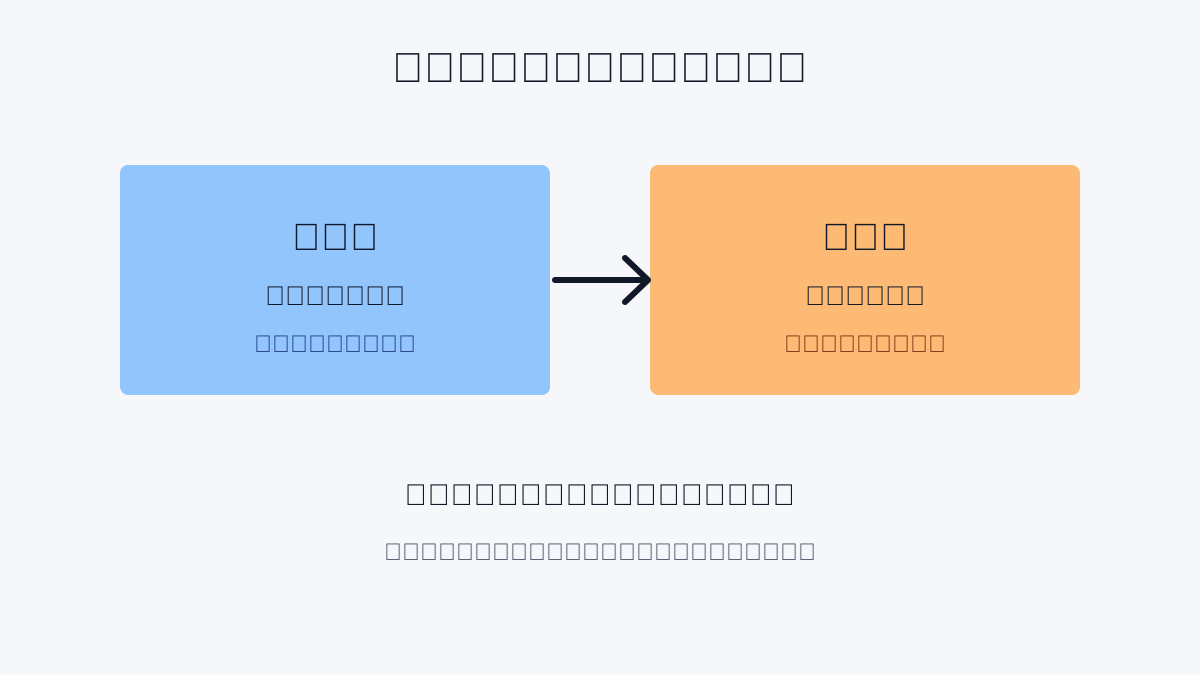
Illustration: Funds between debt and equity
summary
A subordinated equity loan is a special type of loan that, although it is a loan, has characteristics similar to equity.
The points to keep in mind are as follows.
- Legally speaking, it is a loan and must be repaid.
- There is a subordination clause, so the repayment priority is lower than general debt.
- Used as long-term funds and used to strengthen financial structure
- A portion of it may be viewed by financial institutions as something close to capital.
- Interest rates and lender risks tend to be higher than regular loans.
- In corporate analysis, it is necessary to confirm the purpose of use, repayment deadline, subordination clause, interest payment terms, capital recognition ratio, and profit recovery.
Subordinated equity loans are funds that give companies time.
However, even if you give them time, there is no point if the business does not recover. Investors don't feel reassured just by the word "equity credit"; they want to see whether a company can convert borrowed funds into profits and cash flow.
source
- Japan Finance Corporation “Challenge Support Capital Strengthening Special Loan (Capital Loan)”
- [Small and Medium Enterprise Agency "2021 White Paper on Small and Medium Enterprises, Section 2: Impact of the new coronavirus infection and trends in financing"] (https://www.chusho.meti.go.jp/pamflet/hakusyo/2021/chusho/b2_1_2.html)
- Financial Services Agency "Access FSA No. 102"
- Related article: What is a subordinated bond? Repayment order and risks behind high yield
- Related article: What is interest payment deferral? Interest payment deferral risk to be aware of with subordinated bonds