
Related articles
- What is a pension? Basics of National Pension, Employees' Pension, and Old Age Pension
- Easy-to-understand explanation for beginners of the difference between Employees' Pension and National Pension
- What is disability pension and survivor pension? Basics of public pensions, not just old-age pensions
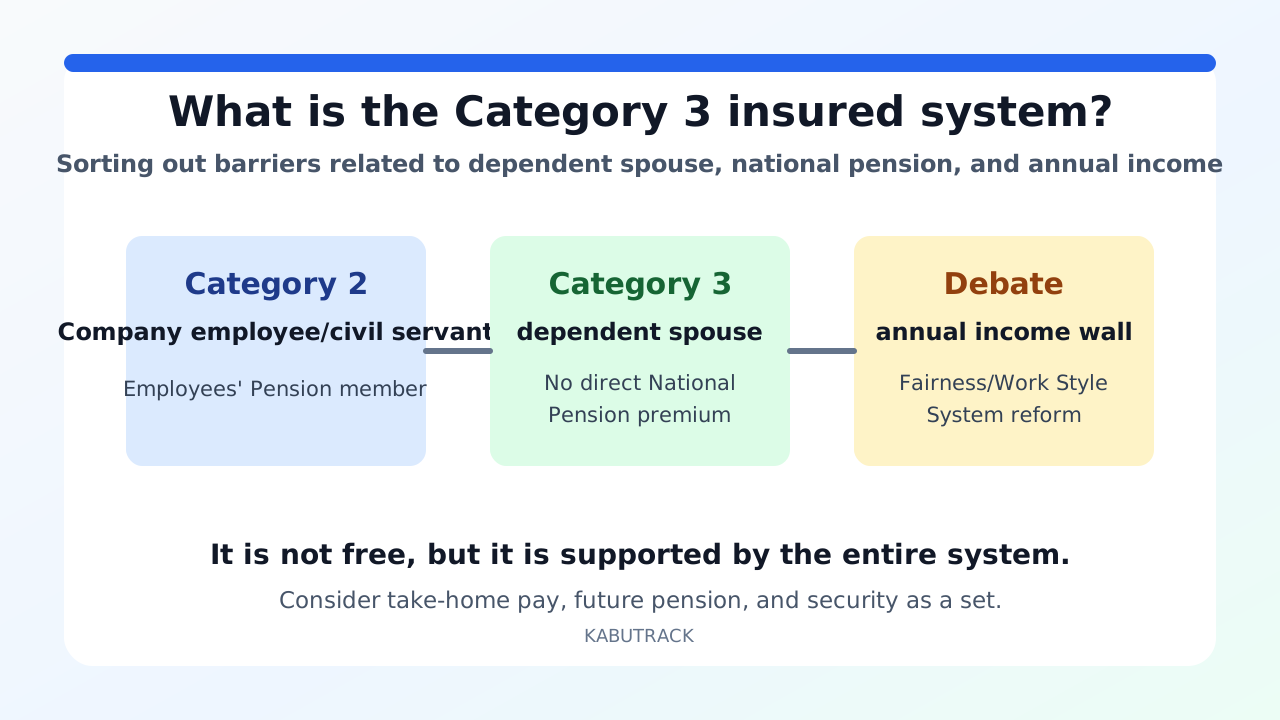
What is the Category 3 insured system?
There are three main types of participation in the National Pension.
| classification | Main target |
|---|---|
| Category 1 insured person | Self-employed people, freelancers, students, unemployed people, etc. |
| Category 2 insured person | Company employees, civil servants, etc. |
| Category 3 insured person | Spouse supported by category 2 insured person |
Category 3 insured persons are, in principle, eligible spouses aged 20 to 60 who are supported by category 2 insured persons.
According to the Japan Pension Service, a Category 3 insured person is, in principle, a spouse with an annual income of less than 1.3 million yen. However, even if your annual income is less than 1,300,000 yen, if you meet the requirements for joining the Employees' Pension or health insurance due to working hours or workplace conditions, you will be classified as a Category 2 insured person instead of a Category 3 insured person.
This is where it can be a bit confusing.
dependent spouse
↓
Not necessarily Category 3
↓
If you meet the social insurance participation requirements at your workplace, you will be eligible for Category 2.
In other words, the Category 3 insured person is not a system for ``only people who are not working.'' Even if you work part-time, if your income and working conditions fall within a certain range, you may be eligible for Category 3.
Why is it called the “spouse pension”?
The Category 3 insured person system was established in conjunction with the introduction of the basic pension system in April 1986.
Prior to that, there was a problem in which it was difficult for full-time housewives of company households to have pension rights in their own names. One of the aims of the system's creation was to allow dependent spouses of company employees to have a basic pension in their name.
For this reason, it has traditionally been called the "housewife pension," though "spouse pension" is more accurate.
However, when trying to understand the current system, it is a little dangerous to look only at this name.
- Target is not limited to women
- The spouse must be a Category 2 insured person, such as a company employee or civil servant.
- The spouse of a self-employed person or freelancer does not qualify as a Category 3 insured person.
- Even if you work part-time, if you meet the requirements for joining social insurance, you will be eligible for category 2.
The correct name of the system is ``Category 3 insured persons of the National Pension''.
You don't have to pay insurance premiums is half true and half dangerous.
A major feature of category 3 insured persons is that even if they do not pay national pension premiums themselves, the period is treated as a period in which premiums have been paid.
The national pension insurance premium for 2026 is 17,920 yen per month. For 12 months, it will be 215,040 yen.
| Item | amount |
|---|---|
| National pension insurance premiums for 2026 | 17,920 yen per month |
| 1 year worth | 215,040 yen |
As a general rule, if you are a Category 1 insured person, you pay this insurance premium yourself. Category 3 insured persons do not pay directly.
However, it is a misunderstanding to think that you can receive a pension for free.
The basic pension for category 3 insured persons is covered by the entire Employees' Pension system. This is supported by the Employees' Pension premiums paid by category 2 insured persons, employer contributions, and national treasury contributions.
From the perspective of household finances, the burden on the individual appears to be zero. Looking at the system as a whole, they support each other through social insurance premiums and tax resources. It is better to understand this separately.
Benefits of category 3 insured person
Category 3 insured persons have advantages in terms of household finances.
1. Do not pay national pension insurance premiums directly
The easiest thing to understand is the monthly insurance premium burden.
In 2026, the national pension insurance premium will be 17,920 yen per month. Category 3 insured persons do not pay this amount directly. The difference is over 200,000 yen per year.
The reason why working households with dependents are concerned about whether they will have to pay social insurance premiums is because of this heavy feeling of burden.
2. Reflected in the period of old-age basic pension
The period of category 3 insured status is treated as the period in which insurance premiums have been paid for the old-age basic pension.
The full amount of the old-age basic pension in 2026 is 70,608 yen per month for people born on or after April 2, 1955. The actual pension amount will vary depending on the number of months enrolled, exemption period, etc., but period 3 is also included in the basic pension calculation.
3. Also related to disability pension and survivor pension
Public pensions are not just for old age.
If you meet the requirements, you will also receive a disability pension when you become disabled due to illness or injury, and a survivor's pension when the person supporting your household dies.
Of course, there are conditions for receiving benefits, such as the date of first medical examination, insurance premium payment requirements, family structure, and livelihood maintenance. Being Category 3 does not mean you will automatically receive every benefit. However, it is important to note that joining a pension system is not only for retirement.
Why abolitionism persists
The Category 3 insured person system is often discussed for review.
There are three main reasons.
1. Two-income households have become mainstream
When the system was created, the household model of a husband who was a company employee and a wife who was a full-time homemaker was more common than it is now.
Nowadays, there are more dual-income households, and more women are working. The number of people who continue to work after marriage, those who move from part-time to full-time work, and the number of households where both husband and wife are enrolled in the Employees' Pension Plan has increased.
As a result, the gap between the household model that was the premise of the system and the actual way of working has become noticeable.
2. There are questions about fairness.
The difference in burden is also an issue.
| Household/work style | How pension insurance premiums look |
|---|---|
| spouse of self-employed person | As the first item, it is easy to pay national pension insurance premiums. |
| dual-income company employee household | Each pays Employees' Pension premiums. |
| Category 3 insured person | The person does not directly pay national pension insurance premiums. |
Even though they all lead to the same old-age basic pension, the individual's burden differs depending on their work style and their spouse's participation system. It's easy to feel a sense of injustice here.
In particular, the spouse of a self-employed person or freelancer cannot be a category 3 insured person. The fairness of the system is being questioned, as only dependent spouses of company employee households will be exempted from paying direct national pension insurance premiums.
3. Employment adjustments taking into consideration the annual income barrier will occur.
The Category 3 insured person system is also related to the so-called annual income wall.
Representative examples are the 1.06 million yen wall and the 1.3 million yen wall.
| wall | rough meaning |
|---|---|
| 1,060,000 yen wall | A level that has been recognized as a guideline for part-time workers to enroll in Employees' Pension and health insurance at their workplace. |
| 1.3 million yen wall | Level at which you are likely to be excluded from spousal support and have to pay for national pensions, national health insurance, etc. |
The Ministry of Health, Labor and Welfare explains that some people adjust their employment to avoid a reduction in their take-home pay due to social insurance premiums.
As the labor shortage intensifies, the situation in which people who are able to work are cutting back on their working hours because they don't want to be left as dependents is a troubling problem for both companies and employees.
How will the 1.06 million yen wall change?
The pension system reform in 2025 expanded the scope of social insurance coverage for part-time workers.
According to the Ministry of Health, Labor and Welfare, the monthly wage requirement of 88,000 yen or more, which has been considered as the so-called 1,060,000 yen barrier, will be abolished within three years of the promulgation of the law. The timing of implementation will be decided based on whether the national minimum wage will be 1,016 yen or more.
However, this does not mean that all annual income barriers will disappear.
What I would like to see as of June 2026 is the following arrangement.
| issue | way of seeing |
|---|---|
| 1,060,000 yen wall | Wage requirements will be abolished within three years of promulgation of the law |
| Company size requirements | Scheduled to be gradually reduced and abolished over 10 years |
| 1.3 million yen wall | Continued to be important in relation to dependent recognition and national pension/national health insurance |
| student | Please note that this is not covered by employee insurance. |
In other words, from now on, you will need to check not only `how much money you earn,'' but also how many hours a week you work,'' how the size requirements of your workplace will change,'' whether you are a student,'' and `what are your employment prospects?''
With the reform of the system, it will be easier for part-time workers to enroll in the Employees' Pension System as Category 2 insured persons. This is not a matter of abolishing the Category 3 insured system all at once, but it can be said to be a reform that will gradually reduce the number of people who remain in Category 3.
What will happen if it is abolished?
If the Category 3 insured person system were to be abolished or significantly revised in the future, there are three main possible directions.
| direction | Impact on household finances |
|---|---|
| Join the national pension as the first person | Individuals are responsible for paying national pension insurance premiums. |
| Enroll in Employees' Pension and health insurance at your workplace | Although you will have to pay social insurance premiums, your future Employees' Pension will increase. |
| Phased transition with transitional measures | The impact may differ depending on age, income, and work style. |
If you pay your national pension insurance premiums yourself, your annual burden will be 215,040 yen based on the 2026 level. This is quite a heavy amount for the household budget.
On the other hand, if you enroll in the Employees' Pension Plan, you will not only have to pay the cost yourself, but also your employer. Although your take-home pay is likely to decrease, your future Old-age Employees' Pension will be added to your income, and health insurance benefits such as injury and sickness allowance and maternity allowance will also be included.
Here, it cannot be simply said that ``the insurance premium increases will cause a loss.''
Short-term: Potential reduction in take-home pay
Long-term: Possibility of increasing pension amount and security
For those who can increase their working hours, the key is whether they can aim for an increase in income that exceeds the decrease in take-home pay after enrolling in social insurance. On the other hand, those who find it difficult to increase their working hours due to nursing care, childcare, illness, workplace circumstances, etc. may face an increased burden.
How should I think about household finances?
When considering the Category 3 insured system, if you judge only based on the immediate income, you will be missing something.
There are five things you should check:
1. Check your current membership category
First, check whether you fall under category 1, 2, or 3.
Even if you think you are supporting your spouse, depending on your work conditions, you may be required to enroll in social insurance at your workplace. On the other hand, it may no longer be a category 3 due to reasons such as your spouse retiring, turning 65, or your income increasing.
2. Check the estimated amount on Nenkin Net
Period 3 will be reflected in the old-age basic pension, but there will be no addition to the Employees' Pension.
It is more realistic to check how the expected future pension amount will change if you work as a dependent and if you work while enrolled in the Employees' Pension.
3. Look at not only the take-home pay but also the security.
If you enroll in Employees' Pension or health insurance, you will be required to pay insurance premiums.
However, not only will your future Employees' Pension increase, but you will also receive benefits that are not available to you under your dependent's health insurance, such as health insurance injury and sickness allowance and maternity allowance.
Look at your immediate take-home pay and the depth of your insurance.
4. Consider the amount of time you can work and your household budget.
If your take-home pay is temporarily reduced by joining social insurance, it is important to increase your income by increasing your working hours.
However, not everyone can easily increase their working hours. Options will vary depending on childcare, nursing care, physical condition, commuting, shifts at work, and division of housework.
It's better to look at whether you can continue with your life as a whole, not just the system's profit and loss.
5. Don't rely solely on pensions for retirement funds.
People who have a long Category 3 period tend to rely mainly on the old-age basic pension, and may receive less additional benefits from the Employees' Pension.
In that case, consider the following combinations of retirement funds:
- Nenkin Regular Mail, Nenkin Net
- deposits and savings
- New NISA
- iDeCo
- Spouse's pension and retirement allowance
- How to work after age 60
Investments are not principal guaranteed. That's why it's natural to first check the estimated amount of your public pension and make up for any potential shortfall through long-term and diversified plans.
Points for investors to look at
The review of the Category 3 insured person system has implications not only for household finances but also for the Japanese economy.
As system reform progresses, the way part-time workers work may change.
| influence | way of seeing |
|---|---|
| labor supply | Increasing part-time working hours will help ease the labor shortage |
| consumption | Changes in take-home pay, social insurance premiums, and concerns about the future affect consumption behavior |
| Company burden | As the number of people enrolled in social insurance increases, the burden on business owners also increases. |
| Human resources strategy | Shift designs will change in retail, restaurants, nursing care, logistics, etc. |
| Social insurance premium income | Increase in insurance premium income by expanding participation in employee insurance |
In retail, restaurant, nursing care, human resources services, etc., if there are fewer work adjustments based on annual income, it will be a tailwind for securing working hours.
However, the employer will be responsible for paying social insurance premiums. It is too early to conclude that this is a positive outcome by looking only at the alleviation of the labor shortage; we need to look at the balance between wages, recruitment costs, social insurance premiums, and price pass-through.
common misconceptions
Misconception 1: No one pays the insurance premium for category 3 insured persons.
This is correct in the sense that the person in question does not directly pay National Pension Insurance premiums.
However, the system as a whole is supported through the Employees' Pension system and national treasury contributions. It is not a completely free system.
Misconception 2: Only housewives are eligible
The target is "spouse supported by Category 2 insured person". Gender is not a condition.
Misconception 3: If it’s less than 1.3 million yen, it’s always Category 3.
Even if your annual income is less than 1,300,000 yen, you will be classified as Category 2 insured person if your workplace meets the requirements for enrolling in Employees' Pension or health insurance.
Misconception 4: If you enroll in social insurance, you will always lose money.
Short-term take-home pay may be reduced. However, there are some aspects in which the Employees' Pension and health insurance benefits will increase. Your profits and losses will vary depending on your income, length of employment, family structure, and future work style.
Misconception 5: The abolition of the Category 3 system has already been decided.
As of June 2026, it has not been decided that the Category 3 insured person system itself will be abolished immediately. However, with the expansion of social insurance coverage, the number of people moving from category 3 to category 2 will likely increase.
Conclusion
The Category 3 Insured Person System is a system that allows spouses of company employees, civil servants, etc. who are dependents to enroll in the National Pension System without having to pay National Pension Insurance premiums themselves.
A major advantage for households is that they do not have to pay directly for national pension insurance premiums. The National Pension Insurance premium for 2026 is 17,920 yen per month and 215,040 yen per year, so I can understand why you are concerned about whether you will remain as a dependent.
However, the entire system is supported by the Employees' Pension System and the national treasury, so it is not completely free. Additionally, as the number of dual-income households increases, discussions are focused on fairness, annual income barriers, and the impact on labor participation.
What is important at this point is not to make two choices: `Is it a good idea to remain a dependent?'' or `Is it a loss to enroll in social insurance?''
Take a look at your current take-home pay, future pension amount, public security for disability and survivors, working hours, and household budget. The more the system reform progresses, the more important this confirmation becomes.
Source
This article was created based on publicly available information from the Japan Pension Service and the Ministry of Health, Labor and Welfare as of June 16, 2026. The pension system, social insurance participation requirements, insurance premiums, and pension amounts are subject to change, so please check with your workplace, Japan Pension Service, pension office, social insurance labor consultant, etc. before actual procedures and household financial decisions.
- Japan Pension Service “What are “Category 1 insured person” and “Category 3 insured person” of the National Pension? Updated date: August 19, 2024
- Japan Pension Service “Explanation of the National Pension Category 3 insured person system”
- Ministry of Health, Labor and Welfare “Major system changes related to the Ministry of Health, Labour and Welfare (April 2026)”
- Ministry of Health, Labor and Welfare “Notice regarding the pension amount revision for FY2026”
- Ministry of Health, Labor and Welfare “Responding to the annual income barrier”
- Ministry of Health, Labor and Welfare “The Pension System Reform Act has been enacted”
- Ministry of Health, Labor and Welfare “Expansion of eligibility for pension social insurance”