
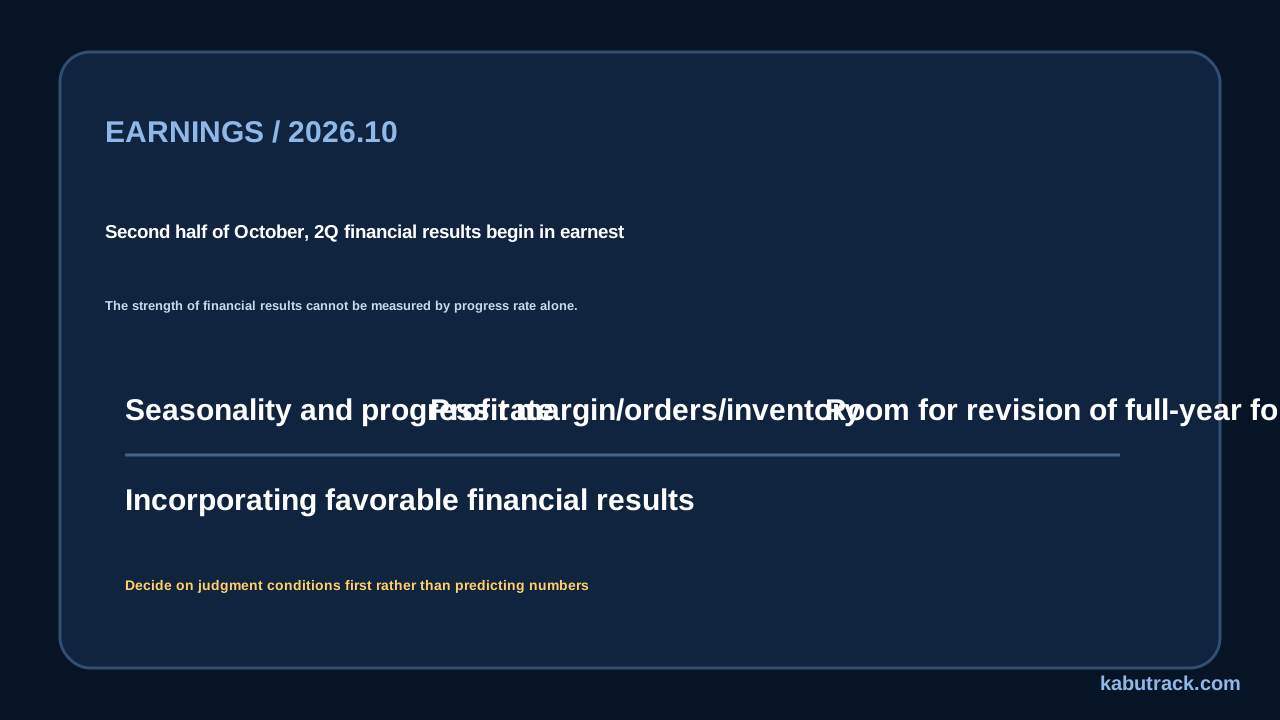
2Q financial results begin in earnest from late October
The interim period for companies with March year-ends is six months from April to September. For companies with different fiscal year-ends, the period covered by “2Q” and “interim financial results” will also change, so the period covered by the financial results report will be the standard.
As of October 1, 2026, Nomura Research Institute (NRI) and ZOZO are scheduled to announce their financial results for the second quarter of the fiscal year ending March 2027 on October 29. Earnings announcement dates are subject to change, and as the announcement approaches, the latest dates in each company's IR will be used as the standard.
Three points to consider before the earnings announcement
Even if the progress rate is over 50%, you can't feel relieved.
The 50% progress rate for the first half is only a guideline. In retail, the year-end sales season, in construction, acceptance inspections, and in manufacturing, the way profits are generated depends on delivery dates and operating rates. Compare the ratios for the same period last year and the first half of the past few years to find out whether the difference in progress is due to seasonal factors or changes in the business.
There are some situations where it is difficult to judge based on sales alone. Has gross profit margin increased due to price increases and product mix improvements, or has it been able to absorb labor and raw material costs? Even if the increase in profits is the same, sustainability will differ depending on whether it is accompanied by profit margins.
Will the full-year forecast change in 2Q?
In 2Q, it will be easy to watch whether there will be an upward revision to the full-year forecast. Even if the first half of the year is strong, the company may keep its forecasts unchanged by carefully looking at costs and delivery dates for the second half. If the forecast is left unchanged, the next point to be discussed is whether or not an increase in costs and deviations in delivery dates are expected in the second half.
Leading indicators also differ depending on the industry. In the case of retail stocks, monthly same-store sales and average customer spending, and in the case of semiconductor manufacturing equipment, orders, backlogs, inventory, and customers' capital investment plans are clues to predict the next quarter. Even if sales grow, if profit margins and order backlogs slow down, there will be little room for the company to exceed its plans.
Why Shares Can Fall Despite Good Results
After a sharp pre-announcement rally, shares can sell off on the news even if earnings beat company guidance, when they fail to meet market expectations. If the stock price has increased by 20 to 30% since the previous financial results, and the P/E ratio is near the upper end of the past range, it will be difficult to exceed expectations with increased profits alone. If the company is expected to accelerate its profit growth rate or make an upward revision for the full year, it can be sold even with strong financial results.
Think about what you expect from the stock price based on the recent rate of increase, position from the high price, expected P/E ratio, etc. The focus is on whether the high P/E ratio is commensurate with the sustainability of profit growth and the difference with peers.
After financial results, separate “numbers” and “stock price reaction”
| earnings | first thing to see |
|---|---|
| upside | Have the full-year forecasts been improved? Isn't it a temporary factor? |
| As expected | What were your expectations for the stock price? Will the investment hypothesis remain? |
| downside | Is it a one-off expense or is the profitability of the main business worsening? |
If the stock price falls even with good financial results, perhaps the company's expectations were too high, or the full-year forecast was insufficient. Even if there is a downturn, one-time costs and a decrease in orders have different meanings. Isolate earnings release numbers, company explanations, and stock price reactions.
Manage Risk Across an Earnings Announcement Through Position Size
If you own 100 shares with a stock price of ¥2,000 and the stock price declines by 10% after the earnings, the unrealized loss is simply calculated to be ¥20,000. In reality, the price may fall more than expected, and the amount of loss cannot be fixed even with a stop loss. Consider the number of shares based on the amount of loss you can tolerate. Separate your living expenses and money you plan to use soon from your investment funds.
All you need to organize in the first half of October is the date of announcement of stocks you own and candidate stocks, indicators to look at in the next financial results, purchase conditions before and after the announcement, and expected losses. By narrowing down the indicators to one to three for each stock, it is easier to stay focused when reading explanatory materials and Q&A after the presentation.
Conclusion
What you need to do before the earnings announcement your accounts is simple. Check the announcement date of the stocks you own, and write down only 1-3 items, such as “If things go wrong in the next financial results, you will sell.” When it comes to financial results, position size is more important than forecast accuracy.
Sources
*Financial results schedule is information posted on each company's IR as of October 1, 2026. Publication dates are subject to change.