
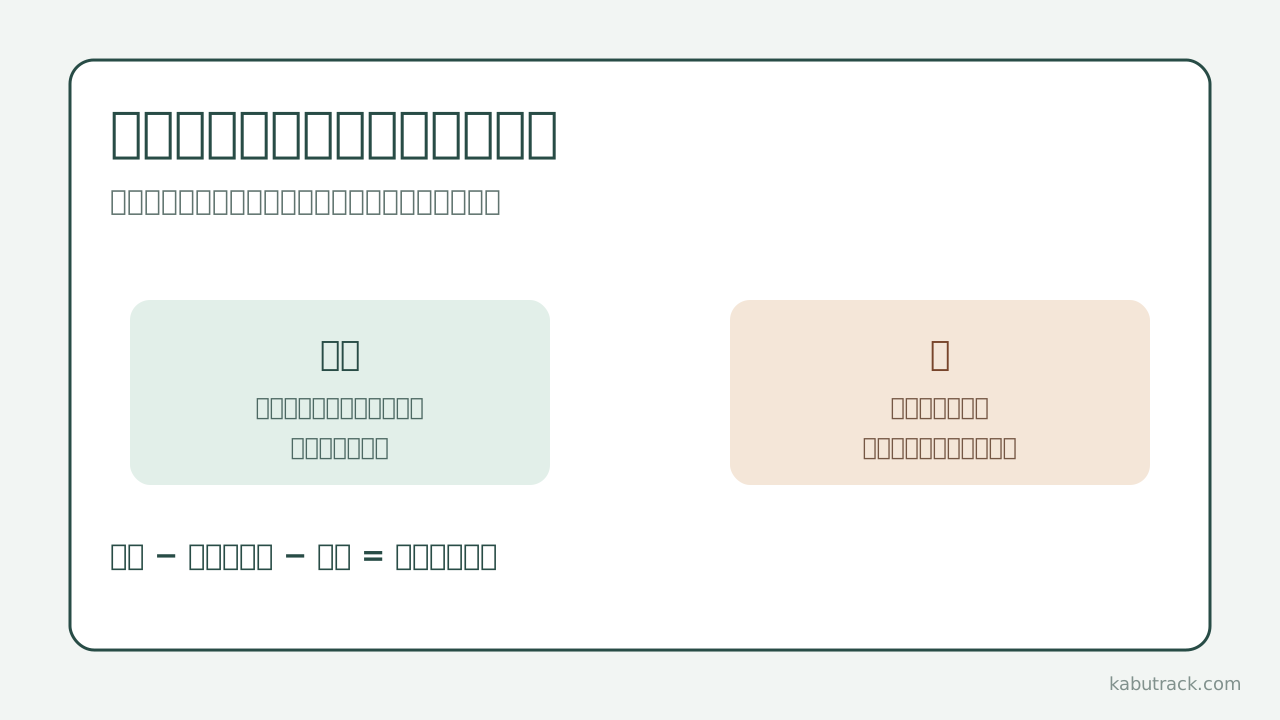
First, the conclusion
Cash is easy to use for splitting and paying taxes, and stocks carry forward future appreciation and dividends. It is not clear which one is better.
| Comparison items | Cash/deposits | Listed stocks |
|---|---|---|
| Inheritance tax evaluation | In principle, face value and balance | Evaluation based on the closing price of the tax period, etc. |
| Price fluctuation | No principle | Yes |
| Tax on sale | Usually none | 20.315% on capital gains in principle |
| Easy to divide | High | Number of shares and market value fluctuate |
| Use for tax payment | Can be used as is | May need to be sold |
It is realistic to confirm the acquisition price of stocks and account classification after securing tax funds and living expenses.
Inheritance tax assessment of listed stocks
As a general rule, listed stocks are valued at the final price on the day of the decedent's death. However, if that price exceeds the lowest of the following monthly averages, you can evaluate at the lowest monthly average.
- Month of death date
- the previous month
- The month before that
Therefore, the market value as of the date of death and the assessed inheritance tax value may not match. Even if the stock price declines after inheritance, there is usually no system to replace it with the lower price at the time of declaration.
Stocks in a taxable account inherit the acquisition price
As a general rule, stocks inherited through a taxable account will inherit the acquisition value of the decedent. It does not automatically round up to the market value at the time of inheritance.
For example, if you sell a stock with a market value of 10 million yen and an acquisition price of 2 million yen for the same amount, without taking into account commissions and profit and loss aggregation, the capital gain will be 8 million yen. If the tax rate is 20.315%, the estimated tax amount is 1,625,200 yen, and the amount deducted from the sale proceeds is approximately 8,374,800 yen.
This is a simplified example. In reality, it will vary depending on selling costs, aggregation of profits and losses from other transactions, addition of acquisition costs, etc.
NISA accounts are treated differently
Listed stocks, etc. that were in the decedent's NISA account cannot be transferred directly to the heir's NISA account. It is accepted into a specific account or general account, and as a general rule, the closing price on the inheritance start date will be the acquisition price of the heir.
It is important to note that unrealized gains during the holding period in NISA will not be carried over as acquisition value in the taxable account. However, the rules are different from inheritance tax assessment.
Special case for acquisition cost addition
If a person who has paid inheritance tax sells the inherited property within a certain period of time, a portion of the inheritance tax may be added to the acquisition cost of capital gains. The deadline is within three years from the day after the inheritance tax filing deadline. Generally, the standard is approximately 3 years and 10 months from the start of inheritance, but the starting date must be confirmed individually.
A final tax return is required for application. It is safer to check with a tax accountant or tax office before selling.
Things to check when dividing inheritance
- Cash needed for inheritance tax, funerals, and living expenses
- Is the stock a taxable account or a NISA account?
- Documents proving the acquisition price of the decedent
- Current unrealized gains/losses
- Difference between inheritance tax assessed value and current market value
- After-tax value assuming sale
- Can the heir accept price fluctuations?
Legally, this does not mean that future sales taxes must be deducted when dividing the estate. However, if you share that the take-home pay can be different for the same market value of 10 million yen, you can reduce the feeling of unfairness later on.
Wrap-Up
Cash has the advantage of certainty and ease of use, while stocks have the advantage of room for growth and dividends. When comparing, look at after-tax value, tax funds, acquisition cost, and account category, not face value. The tax amount will vary depending on your family structure and other assets, so please check with a specialist regarding specific divisions and sales.
Source
- National Tax Agency “No.4632 Evaluation of Listed Stocks”
- National Tax Agency “No.1464 Acquisition costs of transferred stocks, etc.”
- National Tax Agency “No.1463 Taxation when transferring stocks, etc.”
- [National Tax Agency "No. 3267 Special provisions for acquisition costs when transferring inherited property"] (https://www.nta.go.jp/taxes/shiraberu/taxanswer/joto/3267.htm)
- Japan Securities Dealers Association “NISA Frequently Asked Questions”