
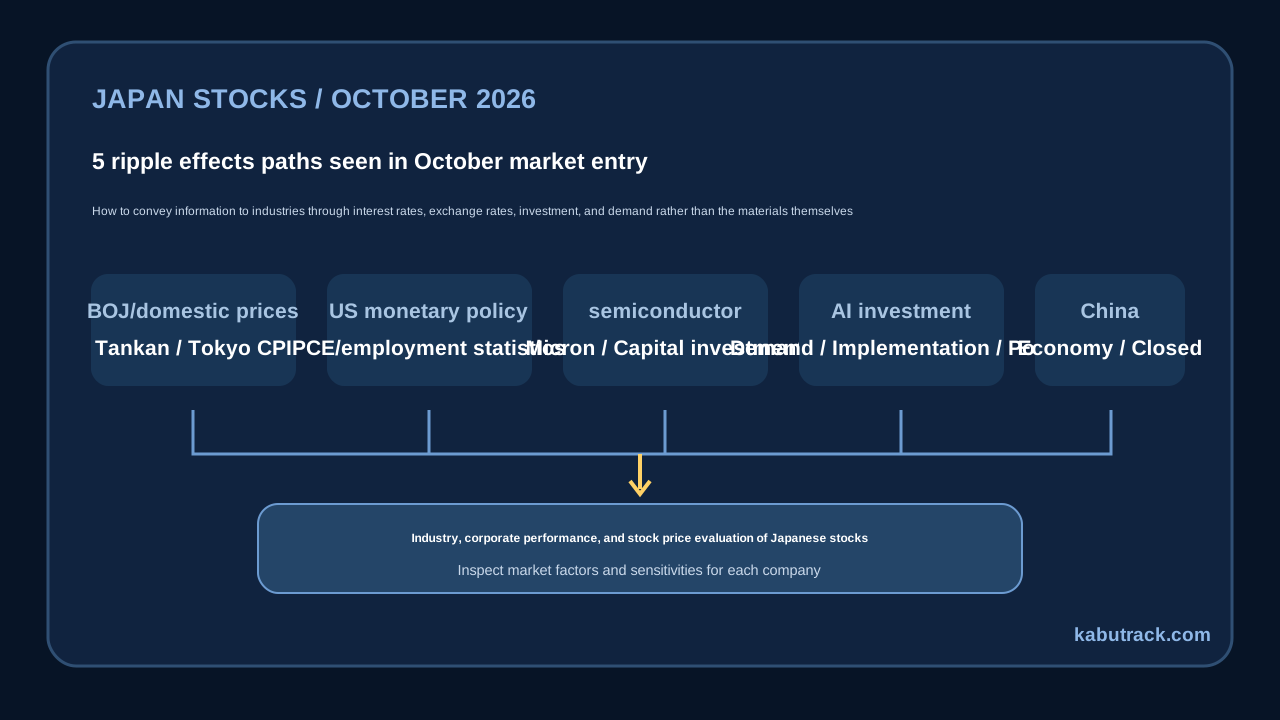
Trace Events Through to Earnings
In early October, economic indicators for Japan and the US, semiconductor earnings results, and AI-related events will continue. What moves the market is not so much the headline of the announcement, but the difference from market expectations and the expectations that have built up to that point. Even if the materials are the same, the reactions of stocks will vary depending on sales composition and stock price trends.
Micron's outlook is a good indicator of the memory market, but the company's product mix and Kioxia's NAND business are two different things. The growth in demand for AI will not continue as a stock-price driver unless it leads to sales and profits for each company.
1. BOJ and domestic prices | Distinguishing the benefits and burdens of interest rate changes
The Bank of Japan is scheduled to release the “Summary of Opinions” from the September 17-18 Monetary Policy Meeting and the September Tankan at 8:50 a.m. on October 1. The Tankan allows you to read not only business conditions, but also capital investment plans and pricing assessments. On October 2nd, the Tokyo wards CPI for September will be announced. Core CPI (all items excluding fresh food) in August increased by 1.8% compared to the same month last year.
Higher rates can help banks’ and insurers’ yields on newly invested funds and lending rates. However, we cannot ignore funding costs such as write-downs on bond holdings, interest rates on deposits, and credit costs in the event of an economic downturn. For real estate companies and REITs, the focus is on borrowing conditions and refinancing timing, and for high PER stocks, the focus is on long-term interest rate movements. The impact on industries will also differ depending on whether only short-term interest rates rise or long-term interest rates also rise.
2. Semiconductors | Read Micron's outlook by product
Micron is scheduled to hold a financial results briefing for the fourth quarter of fiscal 2026 at 2:30 pm on September 30th (US time) (5:30 am on October 1st, Japan time). In addition to the supply and demand of HBM, DRAM, and NAND, we look at data center demand, production capacity, capital investment, and the outlook for the next quarter.
The routes by which it spreads to Japanese companies are not uniform. Kioxia Holdings (285A) is related to NAND and SSDs for data centers, Tokyo Electron (8035) is related to manufacturing equipment investment, Advantest (6857) is related to semiconductor test demand, DISCO (6146) is related to processing processes, and Lasertec (6920) is related to trends in inspection equipment for advanced semiconductors. Even if capital investment continues, the reaction will vary depending on orders, profitability, and prior increases in stock prices.
3. AI|Linking event attention to sales and profits
OpenAI DevDay 2026 is scheduled to be held in San Francisco on September 29th. Even if the announcement of a new feature or model becomes a hot topic, whether it will lead to corporate spending or recurring charges is a different story. What the market wants to know is how the widespread use of AI will turn into revenue.
Related areas for Japanese stocks expand from AI semiconductors and memory to data centers, power equipment, transformers, cooling, communications, and software/SI. Even if the number of implementation cases increases, it is not enough to predict the profit contribution. In addition to related sales, contract unit price, continuation rate, and gross profit margin, we want to track implementation and operational costs. This is also the turning point in moving from demonstration experiments to actual operation.
4. China | Economic Indicators and Information During the Market Holiday
Stock exchanges in mainland China will be closed from October 1st to 7th for the National Day, and are scheduled to resume trading on October 8th. It is difficult to grasp the strength of the economy using the PMI alone. If you also look at new orders, production, export orders, and employment, you can see where momentum is stalling.
For machine tools/FA, construction machinery, materials/chemicals, and automobiles, it takes time for China's policies and capital investments to be reflected in actual orders. When it comes to consumer spending in Japan such as department stores, cosmetics, and hotels, we want to see not only the number of customers but also the amount spent per person. If policy or geopolitical information emerges during the holidays, it may be factored in when trading resumes on October 8th.
5. Foreign exchange and US interest rates | Aligning Fed decisions with economic indicators
At the September 16th FOMC meeting, the Federal Reserve raised the policy interest rate target by 0.25 points to 3.75-4.00%. The next meeting is scheduled for October 27-28. The premise for reading US indicators in early October is not that interest rates will continue to be cut, but rather whether interest rates will be maintained at this level or raised further.
The U.S. Department of Commerce's Bureau of Economic Analysis (BEA) is scheduled to release personal income and spending data for August on September 30th, which will also include the PCE price index. U.S. employment statistics will be released on October 2 at 8:30 a.m. (US Eastern Daylight Time, 9:30 p.m. Japan time). In addition to the headline on the number of employees, we would also like to see the unemployment rate, average hourly wage, labor participation rate, and past revisions.
It would be premature to directly link the strength of US inflation and employment to further interest rate hikes or a weaker yen. In addition to market interest rates, the Fed's statements, the BOJ's outlook, and risk aversion movements also influence foreign exchange rates. While a weaker yen may provide a tailwind to exporting companies' profits in yen terms, it also increases the burden of imported raw materials and fuel. Exchange rate sensitivity and hedging status are important points to look at for each company.
Schedule for early October
| Date (Japan time) | Main schedule | Main routes to see |
|---|---|---|
| September 29th | OpenAI DevDay (US time) | AI usage/data center investment |
| September 30th | US personal income and expenditures including PCE for August (9:30 p.m.) | US interest rate/exchange |
| October 1st | BOJ “Summary of Opinions” September Tankan (8:50 a.m.) | Domestic interest rates/capital investment |
| October 1st | Micron financial results briefing (5:30 a.m.) | DRAM/NAND/Capital investment |
| October 1-7 | Mainland China stock market closed | China-related stocks/Japan consumption |
| October 2nd | Tokyo wards CPI (8:30am) | Price/BOJ outlook |
| October 2nd | US September employment statistics (9:30 p.m.) | US interest rate/exchange |
Conditions that change your perspective
Even if the Tankan and CPI are strong, the BOJ's policy outlook may remain unchanged unless the outlook for wages and underlying prices changes. Even if U.S. indexes are strong, if the market anticipates interest rate increases, the stock-price response may be limited. In semiconductors, even if demand grows, increasing supply capacity will put pressure on profitability, and in China, policy announcements do not necessarily lead directly to a recovery in orders for companies.
After the announcement, we compare how interest rates, exchange rates, and stock prices by industry have responded to the company's orders and profit forecasts. Even if the Nikkei 225 average or TOPIX remain unchanged, funds can still shift between industries.
Conclusion
Early October is a week when there are many factors, and it is difficult to explain the market with a single headline. Tankan/CPI is for domestic interest rates, US indicators are for foreign exchange, Micron and AI investment are for semiconductor orders, and Chinese indicators are for machinery, materials, and consumption. While following each path, we will look at whether the stock price reflects expectations-led buying and whether there is a path to reaching business results.
Related Pages
- BOJ's government bond holdings are approximately ¥518 trillion | 10-year and 20-year bonds account for 68%, who will be the next buyer
- Reading the polarization of the semiconductor sector | Reasons why the price movements of 8035, 6920, and 285A were divided
- Summary of next week's events from September 28 to October 4, 2026 | BOJ Tankan, US employment statistics, OpenAI DevDay, Micron financial results
- September 27, 2026 Next week's Japanese stock outlook | BOJ Tankan - focus on US employment statistics and financial results announcement
Sources
- Bank of Japan “Schedule for head office tour, publicized materials, etc.”
- Tokyo “Tokyo Ward Consumer Price Index (August 2026)”
- Ministry of Internal Affairs and Communications Statistics Bureau “Consumer Price Index Publication Schedule”
- U.S. Federal Reserve Board “FOMC Statement (September 16, 2026)”
- U.S. Federal Reserve Board “FOMC Meeting Schedule”
- U.S. Bureau of Economic Analysis “Publication Schedule”
- U.S. Bureau of Labor Statistics “Employment Statistics Publication Schedule”
- China National Bureau of Statistics “Statistics Publication Schedule”
- OpenAI DevDay 2026
- Micron “Notice of 2026 4th quarter financial results briefing”
- Shanghai Stock Exchange “2026 National Day Closing Schedule”
*The publication schedule is the schedule posted by each institution as of September 27, 2026. Market forecasts and company performance forecasts are not our own estimates.